|
Great British Think Tank · Data not vibes · gbtt.info
GBTT.
Weekly Briefing
| ||||||||||||||||||||||
| Sunday 20 September 2026 · Issue No. 19 | ||||||||||||||||||||||
|
Editor’s Note
Bad week to be a rate-setter. Inflation jumped to 3.1% on Wednesday, crossing the 3% threshold that requires Andrew Bailey to write to the Chancellor explaining himself. A day later, the Bank held rates. Three of the nine MPC members, Megan Greene, Catherine Mann and Huw Pill, wanted to raise rates to 4%. Six didn’t. Somebody’s wrong. The Fed went the other way on Wednesday, raising rates for the first time in three years. Threadneedle Street was right not to copy it. A soft labour market and eighteen months of restrictive rates are already doing plenty of the work, and this month’s inflation rise is largely an external energy story, not a wage-price spiral. As our director argued in CapX on Thursday (see Guest Opinion), the traders now pricing four or five more rate rises have missed that broad money isn’t accelerating. Without it, an oil shock alone doesn’t start a lasting inflation problem. What did catch the eye was the bond selling (QT) update: a further £146bn of active gilt sales stretching towards 2034, when the Bank could let the bonds mature on their own timetable and stop there (see Big Story for the mechanics). Britain remains unusual among big central banks in choosing to keep doing this at all. After a summer promising a gentle, cost-of-living Budget, things are moving quickly. The Times says the mansion-tax threshold could fall from £2 million to £1.5 million — and there is no obvious reason to think it ends there. Overnight, the Mail went considerably further: Labour sources say Burnham is considering an early election to seek a fresh mandate for tax rises, with the Treasury looking for £10–15 billion and income tax apparently back in the conversation. Burnham has previously ruled out a snap poll, so this is still Westminster briefing rather than policy. But if ministers are already discussing an election simply to escape the tax promises they inherited, “challenging” may prove to have been an understatement. For what it’s worth, GBTT had already pencilled in 17 December 2026 as a possible election date. And finally there is PIP. 4.1 million people in England and Wales are now claiming it, up 2% in just three months. Add DLA and the total has climbed from 3.5 million before Covid to 5.4 million. The bill is heading north of £40 billion by the end of the decade. Westminster can keep talking about “difficult choices”, a strong leader would make them. | ||||||||||||||||||||||
|
GBTT Announcement
William Clouston Joins GBTT’s Academic Advisory Council
Former SDP leader William Clouston has joined GBTT’s Academic Advisory Council as one of its founding members. 
Four-time parliamentary candidate. Thirty-five years in planning. Clouston has spent years trying to build policy rather than simply comment on it.
“Exactly what we want the Council to represent.”
Damian Pudner, Director, GBTT
|
||||||||||||||||||||||
|
The Big Story
Inflation Breaks 3% as oil jumps
August’s inflation figure forced Andrew Bailey to write the mandatory explanatory letter to the Treasury. A day later the Bank held rates anyway, voting 6–3 to hold rather than raise.
Consumer prices rose 3.1% in the year to August, up from 2.9% in July and the highest reading since September 2025, the ONS reported on Wednesday. Core inflation held at 2.6%. Goods prices rose 2.7%, their fastest pace in a year, while transport costs, driven mainly by fuel, jumped to 4.6%. Oil, via the Gulf conflict, is the common thread running through the acceleration. The 1.1 percentage-point overshoot against the Bank’s 2% target triggers a legal requirement: the Governor must write to the Chancellor explaining why, and what the Bank intends to do about it. Andrew Bailey and John Healey duly exchanged letters on Thursday, the same day the Monetary Policy Committee voted 6–3 to hold Bank Rate at 3.75%. Megan Greene, Catherine Mann and Huw Pill wanted a rise to 4%, judging the energy shock more likely to feed into wages and expectations than the majority believes. The Bank’s own forecast gives their worry some teeth: CPI is expected to reach roughly 3¾% in the fourth quarter and just above 4% in early 2027, if energy prices hold at mid-September levels. The bigger surprise came from the update on QT. Of the Bank’s £488bn stock of quantitative-easing bonds (down from a £895bn peak in February 2022), £222bn will mature on its own timetable and a further £146bn will be actively sold at £20bn a year, together taking the monetary-policy portfolio down by an average £46bn a year to zero by the end of 2034. A separate £120bn of the longest-dated gilts is being carved out entirely: held to maturity to back Britain’s banknotes, with none of it maturing before 2049. Producer prices point the same way. Factory input costs rose 6.1% on the year, driven by a 26.7% jump in crude oil costs; output prices rose 3.7%, with refined petroleum the largest single contributor. Whatever is driving August’s inflation, it did not start at the check-out. Friday complicated the picture slightly. Retail sales volumes rose 0.5% in August, against expectations for a fall, leaving them 2.4% higher than a year ago. The labour market is weakening, but consumers have not yet disappeared.
| ||||||||||||||||||||||
|
Chart of the Week
Broader Than Headline CPI, But Energy Still Dominates
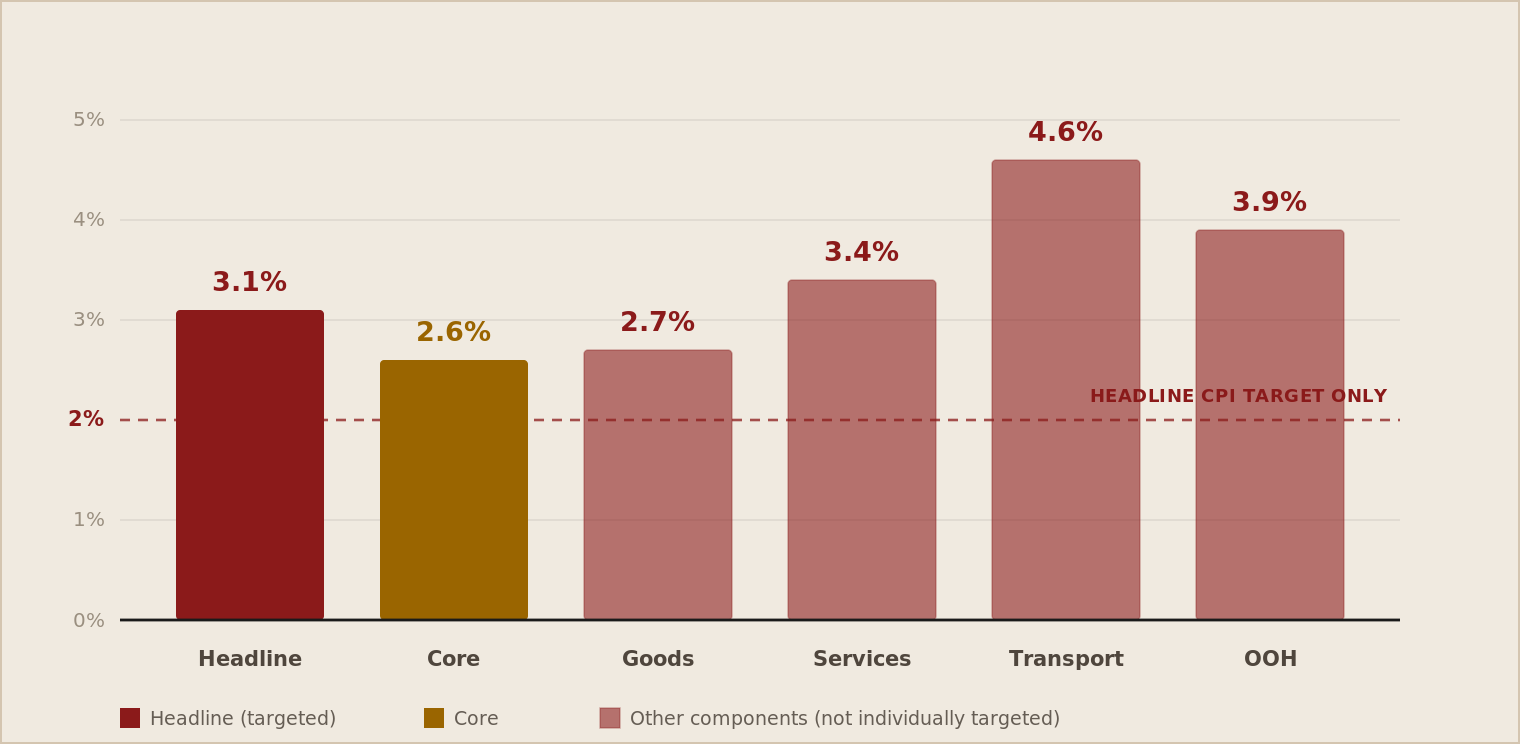
Source: ONS, Consumer Price Inflation, UK: August 2026. Annual % change, 12 months to August 2026. Core CPI excludes energy, food, alcohol and tobacco; OOH is owner-occupiers’ housing costs. The dashed line marks the Bank of England’s 2% target for headline CPI only; the Bank does not target the other measures shown individually.
Every measure here sits above 2%, but only headline CPI is actually targeted at that level; the rest are components, not separate promises the Bank has broken. | ||||||||||||||||||||||
|
Labour Market
Vacancies At An 11-Year Low, And A Pay Gap Nobody’s Explaining
Two days before the Bank’s decision, the ONS delivered evidence for both sides of the argument. Unemployment held at 4.9%, vacancies fell to 702,000, their lowest outside the pandemic since 2014, and payrolls kept shrinking, down 145,000 on the year on August’s flash estimate. That is not an economy crying out for higher interest rates. But look at pay. Public sector regular earnings grew 6.3% over the year, more than twice the private sector’s 2.9%, an increasingly difficult gap to justify when private-sector activity ultimately supports the tax revenues that finance public payrolls. The gap has now widened for four straight periods, from 2.6 points in the spring to 3.4 now. A government wanting credibility on pay restraint might start by explaining that number.
| ||||||||||||||||||||||
|
Gilt Markets & Sterling
Longer-Dated Gilts Rally On The Bank’s QT Update
The 10-year gilt edged up to 5.30% by Friday’s close, less than 2 basis points (0.02 percentage points) above last week. The 30-year told a different story, easing to 5.76%, down 15 basis points (0.15 percentage points) on the week from 5.91%, after the Bank paused its gilt auctions until April 2027 and pulled the longest-dated bonds out of the sales programme altogether, which did more to calm longer-dated yields than the rate hold itself. That relief has a limit: the Bank is still choosing to sell £20bn of gilts a year into a market the Treasury also needs to borrow from, when it could let them mature instead. Sterling slipped to around $1.34 against the dollar, and the FTSE 100 closed at 10,659, essentially flat on the week (+0.08%) after banks and energy stocks dragged the index down 1.45% on Friday. | ||||||||||||||||||||||
|
Political Economy
The Budget Is Now Hostage To The Forecast
The uncomfortable part for Healey is not simply that gilt yields are high. It is how quickly small changes in rates and inflation now punch through the public finances. The OBR’s own ready reckoner says a sustained 1 percentage-point rise in gilt yields and Bank Rate adds around £15–16 billion to annual borrowing by the end of the forecast. A 1-point rise in RPI adds another £11–12 billion. That is why a few months of higher oil prices and a weaker gilt market can consume most of a Chancellor’s headroom before he has announced a single policy. Britain has built a fiscal structure unusually exposed to both. Index-linked gilts transmit inflation into debt-interest costs, while refinancing a large stock of debt at higher yields steadily locks in the new rate environment. The ONS has already recorded sizeable RPI-driven additions to monthly debt interest this year. Office for National Statistics That is the real significance of Burnham calling the Budget “challenging”. The problem is not one bad month or one awkward forecast. It is that the margin for error has become vanishingly small. | ||||||||||||||||||||||
|
Westminster
Reform’s £72 Million Question
Reform UK’s donor problems just got more complicated. Labour MP Phil Brickell has asked the Electoral Commission to investigate the £36m gifts each from Ben Delo and Christopher Harborne, a combined £72m, among the largest donations in British political history. Reform says both donations comply with the law as it stands; the real question is whether they would be caught by new, retrospective restrictions on recently-returned and overseas donors now passing through Parliament, backdated to 25 March 2026. Byline Times has calculated Reform could earn nearly £500,000 in interest were the money ever ordered returned. None of this proves wrongdoing. It does mean Reform’s newfound financial firepower now comes with a regulatory shadow attached, just as the party tries to convert cash into the campaign infrastructure that has been its biggest weakness. | ||||||||||||||||||||||
|
Worth Watching
Britain’s Biggest Taxpayer Wouldn’t Choose Britain Again
Fred Done, who with his brother Peter tops the UK’s individual tax list at roughly £400m paid last year, told the FT this weekend he wouldn’t want to be ‘reborn’ in Britain, citing rising taxes pushing wealth and capital abroad. It’s the same pattern GBTT has been tracking with Christopher Rokos and others: the wealthy don’t usually announce their exit, they just quietly stop being resident. Also worth watching: the ONS admitted this week that it had been overstating hours worked for the best part of a decade, meaning UK productivity growth since the crash was nearly double what the official figures said: 1.3% a year, not 0.7%. A new methodology arrives in November. A decade of Britain’s ‘productivity puzzle’ commentary, ours included, was partly built on the ONS overstating how many hours people were actually working. | ||||||||||||||||||||||
|
Watch & Listen
GBTT This Week
| ||||||||||||||||||||||
|
Guest Opinion
From GBTT and Our Contributors
The Bank Was Right Not To Follow The Fed
Damian Pudner · CapX · 17 September 2026
Markets spent the week pricing four or five Bank Rate rises. Damian calls that ‘lunacy’: Britain’s labour market is ‘exceptionally weak and still weakening’ and broad money isn’t accelerating, so an oil shock alone won’t create lasting inflation. His verdict on the Bank’s new bond-sale plan: right to take the longest-dated gilts out of the active-sales programme, wrong to keep selling any of the rest.
Selling Into the Storm: The Case to Pause QT
Ben Ramanauskas · GBTT Guest Opinion · 16 September 2026
Britain is the only major central bank still actively selling gilts rather than letting them mature, into a global bond glut that has pushed the 30-year yield to its highest since 1998. Ramanauskas’s case: trimming the pace of quantitative tightening, as the Bank did on Thursday, doesn’t go far enough; it should have paused active sales altogether.
| ||||||||||||||||||||||
|
The Rebuild
Nine pounds of every hundred the state spends already goes on interest on what it has borrowed, before a nurse, a teacher or a pothole is paid for. This week’s gilt yields make that line dearer still. Nobody chose it. It is what policy since 1997 left behind, kept in place after 2010. Built by policy, so it can be rebuilt by policy. The Great British Rebuild is where GBTT costs the fixes. See the Rebuild → | ||||||||||||||||||||||
|
Data Calendar
Week of 21–25 September 2026
| ||||||||||||||||||||||
|
GBTT.
Data not vibes
Issue No. 19 · Sunday 20 September 2026 · gbtt.info
Sources: Office for National Statistics, Bank of England, HM Treasury, HM Revenue & Customs, UK Parliament, Ofgem, Electoral Commission, Reuters, Bloomberg, CNBC, MarketWatch, CapX, Byline Times, Pantheon Macroeconomics, gbtt.info. Market data (Friday 18 September 2026): gilt yields and FTSE 100 are MarketWatch closing levels; sterling is a Friday afternoon London reference level, not a formal 5pm fix. 10-year gilt 5.30%, 30-year gilt 5.76%, GBP/USD 1.340, FTSE 100 10,659. BoE base rate 3.75% (held 17 September, voted 6–3, three dissents for 4.00%). Next MPC: 5 November 2026. This briefing is for informational purposes only and does not constitute financial advice. © 2026 Great British Think Tank | ||||||||||||||||||||||