|
GBTT.
Weekly Briefing · Data not vibes
|
| Sunday 27 September 2026 · Issue No. 20 |
Editor's Note Andy Burnham has ruled out an early election. So that’s that, at least for now. He will go to the country after first going through a Budget, another winter of expensive energy and what is becoming a rather uncomfortable argument with the bond market. That last part is partly of his own making. Burnham told the New Statesman he stands by last year’s warning that Britain should be less “in hock” to the bond markets, saying high borrowing has left the country “over-exposed” to global shocks. He is right about the exposure. The awkward bit is that governments do not get to complain about their creditors while continuing to need quite so much of their money. Tuesday’s borrowing numbers were another reminder. The Treasury is taking plenty of tax; the problem is what happens afterwards. Debt interest, welfare and assorted liabilities keep eating through the sums, while gilt yields make every future calculation a little nastier. John Healey has just over a month until his first Budget. Nobody should envy him. Threadneedle Street is not making life any easier. Clare Lombardelli is now talking openly about tighter monetary policy if the energy shock persists. Perhaps. But petrol becoming dearer is not the same thing as Britain developing another monetary inflation problem. Tuesday’s money numbers will tell us rather more about that than another speech from an MPC member. Elsewhere, Ineos is mothballing plants in Hull while pointing to European gas prices twelve times those in America, the benefit cap is quietly biting harder, and long gilts remain the sort of market best viewed through one’s fingers. Wetherspoon’s full-year results on Friday are eagerly awaited: the City expects profits down by around a fifth, and Sir Tim Martin’s verdict on the cost of running a pub will make better Budget reading than most of what comes out of Liverpool. So no election. No easy Budget. And, despite Burnham’s complaints, no escaping the bond market either. |
The Big Story £8.1bn Over Plan, A Month Before The BudgetAugust’s borrowing figures were not the ones Healey wanted, with one more set still to come before his first Budget on 28 October. Borrowing, August £18.3bn £3.5bn above the OBR forecast; second-highest August on record in cash terms, behind 2020 |
| Borrowing, Apr–Aug £77.3bn £8.1bn (11.7%) above the OBR's March profile; £2.2bn below last year |
| Net Debt 93.8% of GDP (£2,985.5bn). 0.8pp below the OBR forecast |
|
The government borrowed £18.3bn in August, £2.9bn more than a year earlier. Ministers will point out that borrowing so far this year is £2.2bn lower than last year. True, but beside the point. The Budget is judged against the path the OBR set in March, and on that path borrowing is running nearly 12% hot. Debt interest came to £8.8bn, the highest August in cash terms since monthly records began in 1997. Around £2.1bn of that was the RPI uplift on index-linked gilts. Britain has a lot of those, so when RPI rises the interest bill simply follows it up, with no vote and no Budget line. The revisions didn’t help. Borrowing for the year to July was nudged up by £2.3bn, largely on weaker tax receipts, and last year’s total went up by £4.5bn to £134.3bn, mostly thanks to local government. At the start of September, Bloomberg Economics reckoned higher borrowing costs and inflation would knock about £12bn off the £23.6bn cushion against the fiscal rules in the March forecast. Tuesday did nothing to put it back. Healey can raise taxes, cut spending or hope the OBR cheers up about growth. His boss spent the week making the first of those harder. |
Chart of the Week The £8.1bn Overshoot
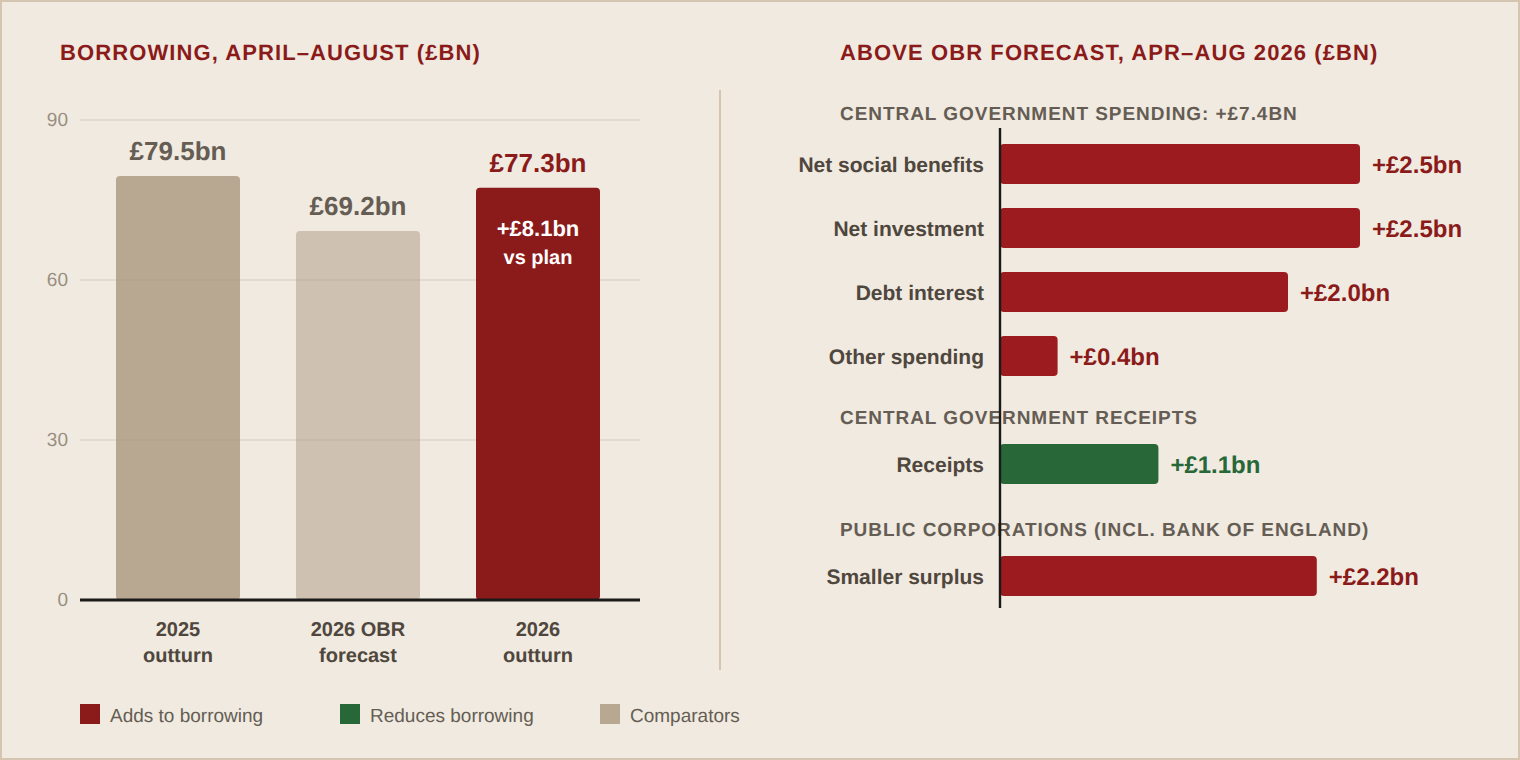 Sources: ONS, Public Sector Finances, UK: August 2026 (left panel: public sector net borrowing excluding public sector banks, April–August, not seasonally adjusted); OBR, Commentary on the Public Sector Finances: August 2026 (right panel, central government items, April–August 2026 versus the OBR's March 2026 monthly profile); ONS Table 8 (public corporations: surplus of £5.8bn against a forecast £8.0bn). ‘Other spending’ is the remainder of the £7.4bn central government spending overshoot after the three named items. The right panel does not sum exactly to the £8.1bn overshoot in total public-sector borrowing, which also covers local government and other items. The OBR's benefits figure (+£2.5bn) differs slightly from the ONS's (+£2.4bn). Published 22 September 2026. Tax is roughly doing its job: receipts are £1.1bn ahead of the OBR’s forecast, while spending is £7.4bn over, mostly on benefits, investment and debt interest, and public corporations, the Bank of England among them, are £2.2bn short of their expected surplus. A Budget that answers all this with tax rises would be fixing the part of the ledger that is broadly working. |
Bank of England The Bank Edges Towards A RiseBank Rate 3.75% | Next MPC 5 Nov | OECD: UK GDP 2026 1.1% |
Clare Lombardelli is the Bank’s deputy governor for monetary policy and one of the nine members of its Monetary Policy Committee, which sets interest rates. She voted to hold in September. In Warsaw she chose her words carefully, but the drift was clear enough. Brent was up 26% since the Bank’s July forecast, to around $98 a barrel as of Tuesday, and two-year fixed mortgage quotes are more than a percentage point higher than before the conflict. On Friday, Moneyfacts put the average two-year fix at 5.92% and the average five-year at 5.94%. So far, she said, the knock-on to other prices has been smaller or slower than expected, and it is ‘too early to tell’ whether wages and price-setting follow. That is someone keeping November open rather than booking it. The OECD is less hawkish. On Wednesday it nudged UK growth up to 1.1% for this year and pencilled in no change in rates until late next year. The markets have other ideas: the September minutes show the short-term rate curve peaking at around 4.9% by end-2027, though the Bank says some of that is risk premia rather than expected policy. One of those views will look foolish by Christmas. |
Energy & Industry Twelve Times The American PriceFlash Composite PMI 51.7 | Firms Worried By Energy 64% | Ofgem Cap From 1 Oct £1,723 |
Ineos said on Tuesday it is mothballing all three acetyls plants at its Hull site, which it calls Europe’s last world-scale operation of its kind. The reason: European gas at twelve times the American price. Ineos says the plants support almost 4,000 jobs, though no redundancies are planned for now. A day later, provisional ONS figures showed Hull and East Yorkshire as the only combined authority with published data whose economy shrank in 2024. It had a head start. Ineos is merely the loudest. Nearly two-thirds of firms (64%) told the ONS they are worried about energy prices, up five points in a fortnight; in hospitality it is 90%. September’s flash PMI slipped to a three-month low of 51.7 (above 50 means growth, below 50 shrinkage), while input costs rose at their fastest since June. S&P Global reckons September alone points to growth of about 0.1% a quarter. Slower growth, rising costs: the combination nobody at the Bank or the Treasury wants to see. |
Gilt Markets & Sterling A Global Sell-Off, With A British Accent10-Year Gilt 5.36% | 30-Year Gilt 5.85% | GBP/USD 1.324 | FTSE 100 10,695 |
Another week, another leg up. The 10-year gilt yield finished Friday at 5.36%, up 6 basis points (0.06 percentage points) on the week, and the 30-year at 5.85%, up almost 10, even after both eased on Friday. On Thursday the 10-year briefly touched 5.42%, its highest since 2007. Higher yields mean the Government pays more to borrow, and the same pressure finds its way into fixed-rate mortgages. In fairness, not all of this is home-grown: the US 30-year Treasury yield hit its highest since 2004 on Thursday. But sterling told its own story, slipping just over 1% to $1.324, while the FTSE 100 managed 0.3% to 10,695. Meanwhile the Bank remains committed to £20bn of gilt sales a year, part of an average £46bn-a-year unwind to 2034, though its sale auctions are paused while it considers selling to the Government instead. Dave Ramsden explains on Monday. Global sell-off or not, Britain still pays a premium for too much debt and too little credibility. |
Political Economy Everyone Wants A Tax Cut. Nobody Has The MoneyBurnham told reporters on the way to New York that ‘we have to be conscious of the extent to which we have raised revenue.’ Translation: he would rather not raise taxes again. Bloomberg, meanwhile, reports the Treasury is eyeing banks, oil and gas, and gambling. Reluctance, it seems, is selective. The Liberal Democrats, unburdened by a Budget, went further. Ed Davey wants the personal allowance up from £12,570 to £15,000 and the higher-rate threshold up to £56,000: a package the Commons Library costs at £17bn a year by year five. The party says it would be paid for by the dividends of a new Growth and Defence Partnership with Europe, which it reckons would raise £27bn a year in extra tax. Reform UK has pledged the same £15,000 allowance, costing it at £17.7bn in year one and paying for it largely from £52bn of welfare savings it has yet to itemise. GBTT has argued for it too. Everyone agrees on the allowance; nobody agrees on who pays. A permanent tax cut resting on a growth dividend that would first need years of haggling with Brussels is not so much costed as hoped for. |
Westminster The Benefit Cap Quietly BitesHouseholds Capped 160,000 | Newly Capped, Mar–May 58,000 | Average Cut £346/mo |
The benefit cap is doing rather more work than anyone announced. DWP figures out on Tuesday show 160,000 Universal Credit households capped in May, up 53,000 since February. The 58,000 newly capped in the quarter is the most since spring 2020, and the average household is losing £346 a month, up from £237. Seven in ten are single parents; the most common number of children in a capped household is now three. The jump coincides with April’s uprating, the rebalancing of Universal Credit and the scrapping of the two-child limit, while the cap itself stayed frozen. The DWP says it cannot tell how much each change contributed. The Treasury will not complain either way: a frozen cap is a spending control nobody has to announce. |
Global Context Hormuz Talks, And A Frosty Word On ChagosOil spent the week lurching about on hopes for the Strait of Hormuz. Bloomberg reported on Thursday that Washington and Tehran are exploring a phased reopening, with Qatar in the middle. Markets have been here before: a similar memorandum in June fell apart within weeks. For Britain, this is the story that decides most of the others. Energy is the main source of the inflation overshoot and the main reason the MPC is talking about rate rises at all. At the UN, Burnham had his first face-to-face with Donald Trump, who called him a ‘natural business person’ and the Chagos deal ‘terrible’. One compliment, one insult: about par for the course. The 10% US tariff on British goods stays put. |
Watch & Listen GBTT This Week
 Pints & Policy · with Benedict Spence · 23 September 2026 With Parliament in recess, Damian and Benedict Spence take UN week: whether Tehran can simply wait Trump out, the Chagos deal heading for the shelf, the new National Centre for Information Defence, Britain's approach to regulating AI, and the OECD's 1.1% growth forecast. |
 Damian on UK Live · 24 September 2026 A £500m Universal Credit spending card ‘doesn't touch the sides’ of a welfare bill heading for £400bn. Damian on £3tn of debt and £110–120bn a year in interest, who actually receives it, why gilt yields keep rising, and the £57bn of welfare savings he says are achievable within three years. |
 Pints & Policy · with Marcus Ashworth · 26 September 2026 Gilts at 5.36% leave an awkward question: who is selling? Damian and Marcus Ashworth discuss hedge-fund unwinds, Big Tech borrowing and the Fed’s rate rise, why dearer energy is a poor reason to raise rates, and what Healey can do at the Budget. The Bank’s rethink on gilt sales offers taxpayers a rare piece of good news. |
|
Guest Opinion From GBTT and Our ContributorsThe Jobs Darren Jones Is Worried About Are in ArnoldAnglofuturism Capital LP · Guest Opinion · 24 September 2026 · 17 min read A credit risk manager in Arnold, Nottingham, has paid in for 25 years. If AI takes his job, contribution-based JSA hands back roughly eight weeks of his own tax. The piece compares Arnold with Lyon, traces how Britain dismantled earnings-related unemployment insurance, and asks what the offer is to the white-collar middle. The £5.34 PintGary B · Guest Opinion · 22 September 2026 · 8 min read Only a fraction of your £5.34 pint is the beer. Gary B argues the pub, one set of accounts absorbing at least five separate arms of the state, none reconciled against the others, is the cleanest test of whether government can see its own cumulative impact. |
The Week Ahead What Matters This WeekMONDAY 28 SEPTEMBER Healey and Ramsden Healey gives his first conference speech as Chancellor in Liverpool. At 11:00 the Bank’s Dave Ramsden explains its new plan for shrinking its gilt holdings, including why its sale auctions are on pause. TUESDAY 29 SEPTEMBER · 09:30 Money and Credit, August The number we’ll be watching most closely this week. If money growth (M4ex) stays subdued, the case that the energy shock turns into lasting inflation stays weak, whatever the hawks say. Burnham gives his first conference speech as Prime Minister later in the day. WEDNESDAY 30 SEPTEMBER · 07:00 Revised second-quarter GDP The fuller picture of spring growth, with revisions, the saving ratio and real disposable income. The Bank’s Financial Policy Committee also publishes its latest record. THURSDAY 1 OCTOBER · 13:00 Catherine Mann One of the three who voted for a rise in September, so worth hearing. The final manufacturing PMI lands at 09:30 (above 50 means expansion, below 50 contraction). FRIDAY 2 OCTOBER Decision Maker Panel What firms themselves expect for prices, wages and hiring. The MPC reads it closely; a jump in expected price rises would hand November’s hawks another argument. Wetherspoon reports full-year results the same day. |
What did you think of the newsletter? We try to appeal to a broad audience. Tell us what you’d like to see more (or less) of by emailing [email protected] |
GBTT. Data not vibes Issue No. 20 · Sunday 27 September 2026 · gbtt.info
Sources: Office for National Statistics, Moneyfacts, Hargreaves Lansdown (via PA), Reform UK, Office for Budget Responsibility, Bank of England, Department for Work and Pensions, OECD, S&P Global, Ofgem, Bloomberg, New Statesman, Liberal Democrats, Ineos, MarketWatch, gbtt.info.
Market data (Friday 25 September 2026): gilt yields and FTSE 100 are MarketWatch closing levels; sterling is a Friday evening London reference level, not a formal 5pm fix. 10-year gilt 5.36% (18 Sep: 5.30%), 30-year gilt 5.85% (5.76%), GBP/USD 1.324 (1.340), FTSE 100 10,695 (10,659). The 10-year's 5.42% on Thursday 24 September was an intraday high, not a close. BoE base rate 3.75% (held 17 September, voted 6–3, three dissents for 4.00%). Next MPC: 5 November 2026.
This briefing is for informational purposes only and does not constitute financial advice. © 2026 Great British Think Tank |
|
