GREAT BRITISH
THINK TANK |
GBTT.
Weekly Briefing
|
DATA NOT VIBES
gbtt.info |
|
|
| SUNDAY 13 SEPTEMBER 2026 · ISSUE NO. 18 |
|
Editor's Note
John Healey went to Coventry this week to make his first big speech on growth as Chancellor. On the same day, Jaguar Land Rover confirmed plans to cut around 4,000 jobs, roughly a tenth of its global workforce. The timing could hardly have been worse.
To be fair, Healey got some help from the growth data: GDP rose 0.4% in July against expectations of zero. But the three-month picture is weaker, slowing from 0.8% in April to 0.4% in July, with services doing the heavy lifting while production and construction went backwards.
The bond market was less impressed. Gilt yields hit new multi-decade highs (the 10-year at its highest since 2007, the 30-year at its highest since 1998) before both eased slightly on Friday. Brent also finished above $100 a barrel for the first time since July as the Gulf conflict intensified.
That has produced market pricing of the Bank of England needing to hike rates four times over the coming twelve months. This is nonsense. The domestic data does not support it. Bailey was right to warn a persistent energy shock could become a problem if it feeds into expectations and prices, but was equally clear markets are pricing an energy risk premium, not another tightening cycle. Ramsden sounded more relaxed, calling domestic inflation pressure "relatively benign": hardly the picture of an economy overheating.
Then came Friday's political bombshell. Ben Delo pledged £36 million to Reform UK, reported as the largest single UK party donation on record. That was quickly followed on Saturday by another £36 million pledge from Christopher Harborne. The news came as police expanded their inquiry into alleged illegal Reform donations, with Farage separately facing scrutiny over a £5 million gift. Reform has already proved it can win votes; what it has lacked is the infrastructure around them. Money like this changes that quickly.
All of this lands six weeks before the Budget, with Healey still refusing to rule out tax rises. For a Chancellor trying to sell a growth story, the week did him few favours.
Finally this week, Tim Martin takes aim at Britain’s increasingly hostile climate for the hospitality industry. We couldn't agree more.
|
|
The Big Story
Oil Tops $100 For The First Time Since July
Iran attacked ten vessels near the Strait of Hormuz this week, Houthi forces seized the Yemeni port of Mocha and Brent finished above $100 a barrel for the first time since July. For Britain, that matters well beyond the petrol station: higher energy prices feed into inflation, household bills, gilt yields and the Chancellor's Budget fiscal headroom.
|
Brent Crude, Fri Close
$104.61
Up 8.7% on the week, having briefly traded above $108 earlier on
|
|
|
Weekly Move
+8.7%
Eased back from a sharper intra-week gain as Gulf diplomacy reports circulated Friday
|
|
|
Hormuz Transits, Thu
7
Against a ten-day average of 14 vessels (Reuters)
|
|
Brent settled on Friday at $104.61, up 8.7% on the week, having briefly traded above $108 earlier on. Hormuz traffic has also fallen sharply, with just seven vessels recorded on Thursday against a ten-day average of fourteen, according to Reuters ship-tracking data.
The pressure intensified after Iran's Revolutionary Guard attacked ten ships near the strait on Wednesday, following further US strikes on Iranian oil tankers earlier in the week. The Guard has threatened to escalate again if attacked. At the same time, Houthi forces aligned with Tehran took control of Mocha, adding disruption around the Red Sea to the problems already choking traffic through Hormuz.
Oil came off its highs on Friday after reports that Gulf foreign ministers were seeking a temporary arrangement with Tehran to keep shipping moving. Useful, yes. A resolution, no.
For British households, Ofgem's October-to-December price cap is already fixed at £1,723 for a typical dual-fuel household, covering around 22 million default-tariff customers. January's review is the one to watch now. Oil's recent price action is unlikely to make that easier.
The bigger question is where oil goes from here, and on that there is remarkably little agreement. The IEA and OPEC are almost three million barrels a day apart in their forecasts for global demand (see Global Context).
One of them is going to be badly wrong.
|
|
Chart of the Week
Growth Has Halved Since April
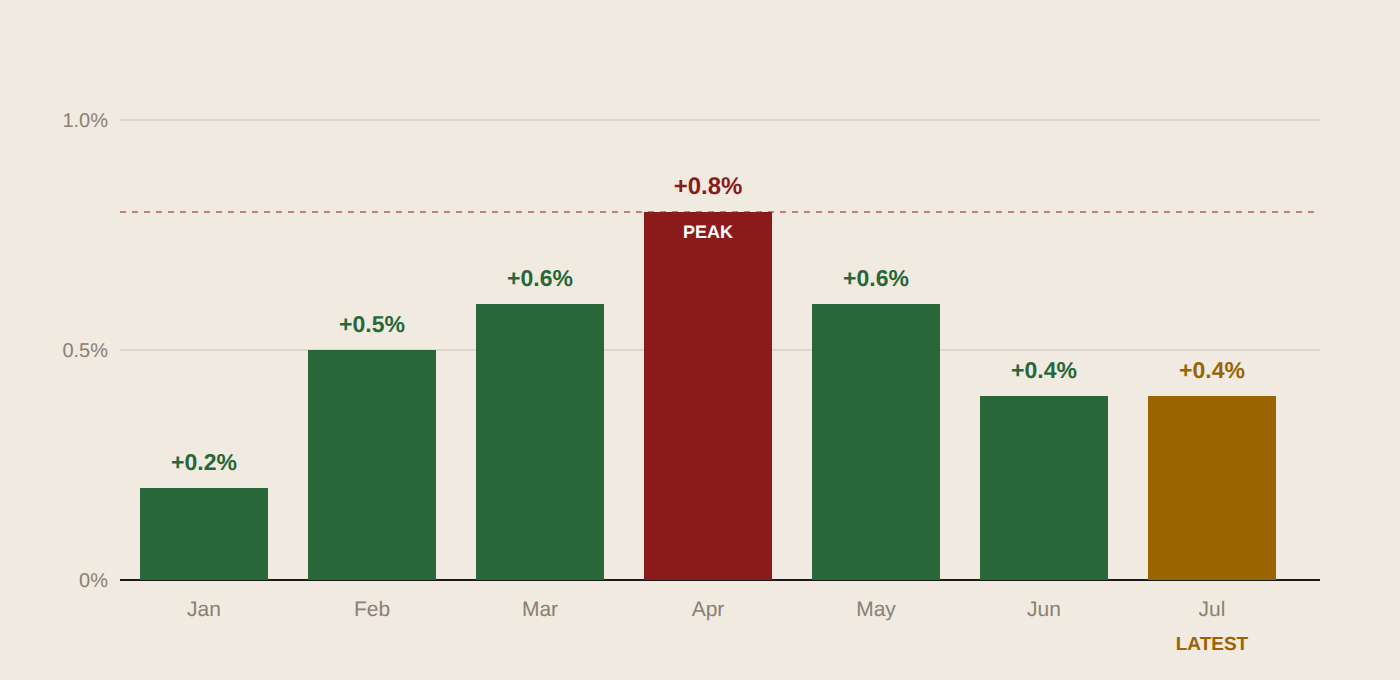
Source: ONS monthly GDP releases. Three-month-on-three-month real GDP growth, seasonally adjusted, January–July 2026, from the July 2026 release. May, June and July reflect the latest published values; January–April are from prior monthly releases and remain subject to revision when the full series reopens with the 30 September 2026 Quarterly National Accounts and the 15 October 2026 Blue Book update.
Three-month GDP growth climbed steadily through the opening months of 2026, reaching 0.8% in April, before easing to 0.6% in May and 0.4% in June and July. July nonetheless marked the eighth consecutive three-month-on-three-month rise in GDP, even as the pace of that growth has roughly halved since April.
Services are doing almost all the work. They grew 0.6% over the latest three months, helped in July by a 3.5% jump in computer programming and consultancy. The ONS says many of the strongest respondents were in AI and cloud computing.
Production and construction, by contrast, both fell 0.5%.
July's monthly GDP figure beat expectations: +0.4% against a forecast of zero. But the monthly number and the three-month trend are telling different stories. Ministers will naturally prefer the first. We would keep an eye on the second.
|
|
Gilt Markets & Sterling
Yields Hit Fresh Highs As Energy Risk Returns
|
10-Year Gilt
5.28%
|
30-Year Gilt
5.91%
|
GBP/USD
1.352
|
FTSE 100
10,650
|
The gilt market had another difficult week. The 10-year finished at 5.28%, up 12 basis points (0.12 percentage points) from the previous Friday's 5.16%; the 30-year closed at 5.91%, having touched its highest level since 1998 before easing back.
Bailey told the Treasury Committee that investors are pricing an energy-related risk premium into the path of interest rates, not a fresh tightening cycle: a case this week's domestic data broadly supports. A higher gilt yield means the Government pays more to borrow, which narrows the Chancellor's room ahead of next month's Budget.
Talk of four rate rises is nonsense on the domestic evidence we have. July CPI was 2.9%, core inflation 2.6% and services inflation 3.4%. According to the Bank of England's September Agents' Summary, pay settlements are running around 3.6%, employment intentions are broadly flat and recruitment difficulties remain below normal.
The FTSE 100 closed the week around 1.7% lower than on 4 September, while sterling held near $1.352. August's CPI lands Wednesday, followed by Thursday's MPC decision.
|
|
Political Economy
JLR Cuts 4,000 Jobs As Healey Talks Up Growth
|
Jobs Cut
~4,000
Roughly 10% of JLR's global workforce, over two years
|
|
|
Cost-Cutting Plan
£1.7bn
$2.3bn; salaried and management roles mainly affected
|
|
|
Tariff Cost, Last Year
£410m
Reported cost of US tariff exposure
|
|
John Healey promised on Monday to "draw a line" under rising costs for business. Jaguar Land Rover chose the same day to confirm around 4,000 job cuts.
The reductions amount to roughly a tenth of JLR's global workforce and will fall mainly on salaried and management roles over the next two years. Factory workers are largely spared, with voluntary redundancies preferred where possible. JLR employs around 43,000 people worldwide, about 34,000 of them in the UK.
JLR's problems are not mysterious. It has been hit by US tariffs, a lingering cyberattack and Chinese EV manufacturers it is struggling to match on price. Reported estimates put JLR's US tariff cost last year at around £410 million.
Healey's Coventry speech leaned on a £150 million scale-up fund for northern firms and the claim the economy is "turning a corner". Perhaps, but it helps to make that argument from a manufacturing centre where one of Britain's biggest manufacturers is not cutting thousands of jobs on the same day.
|
|
Westminster
Water Nationalisation: Three Measures, Three Very Different Numbers
|
Ofwat (2026 RCV)
£117bn
|
OBR (PSNFL Increase)
£78bn
|
Frontier (Cost To 2030)
£144bn
|
MPs will hold a non-binding Westminster Hall debate on Monday on a petition calling for a referendum on public ownership of the water sector. More than 200,000 people have signed it.
The numbers being thrown around make the argument look simpler than it is.
Ofwat puts the sector's 2026 regulatory capital value at just over £117 billion. The OBR estimates that moving water companies onto the public balance sheet would increase public-sector net financial liabilities by around £78 billion. Frontier Economics, commissioned by Thames Water's creditor group, puts the cost of nationalisation at £144 billion by 2030 using an RCV-based approach.
Those are three different measures answering different questions, not three versions of the same calculation.
The Government has called nationalisation a distraction from cleaning up rivers and seas. Prime Minister Andy Burnham has described privatisation as a "leaking monument", without yet committing himself to reversing it.
|
|
Global Context
The World's Top Oil Forecasters Are 2.9 Million Barrels Apart
The IEA and OPEC are looking at the same oil market and reaching almost opposite conclusions.
The IEA expects global oil demand to fall by 2.5 million barrels a day in 2026. OPEC, despite cutting its own demand-growth forecast for a fifth consecutive month, still expects demand to rise by 380,000 barrels a day.
That is a gap of almost 2.9 million barrels a day.
Forecasting oil demand is difficult enough in normal conditions. With Hormuz disrupted, war risk back in prices and shipping routes under pressure, it becomes harder still.
Both forecasts cannot be right. The difference between them is large enough to matter for inflation, interest rates and the UK Budget.
|
|
Guest Opinion
From GBTT and Our Contributors
The Hidden Subsidy Pricing Young Britons Out of Work
Ian Parkinson · Immigration · 4 September 2026
Ian Parkinson argues that Britain's migration system creates a hidden financial advantage for overseas workers which no youth employment scheme can realistically match. His proposed answer is equally direct: a levy on non-domestic hires, longer qualifying periods for state entitlements, tighter student-loan rules and a landlord surtax on lets to non-citizens.
One Of Britain's Biggest Taxpayers Has Left — Who Can Replace Rokos?
Damian Pudner · City AM · 9 September 2026
Chris Rokos paid an estimated £330 million in UK tax last year, making him Britain's third-largest individual taxpayer. He has now moved his tax residency to Greece and opened an Athens office for Rokos Capital Management. The fashionable assumption behind wealth taxes is that wealthy people will sit still while governments increase the bill. Rokos has just provided a rather expensive reminder that some of them will not.
|
|
Must Watch
This Week's Must Watch

Market strategist Michael Brown and our director Damian Pudner chat about bond yields, growth data, the Bank of England, and those donations to Reform UK. One video, 10 mins, worth your time this week.
|
|
Data Calendar
Week of 14–18 September 2026
Monday 14 September 2026
|
MED
|
Westminster Hall Debate: Water Sector Public Ownership Petition
UK Parliament, Petitions Committee
MPs hold a non-binding Westminster Hall debate on a petition, signed by more than 200,000 people, calling for a referendum on returning the water industry to public ownership (see Westminster).
|
Tuesday 15 September 2026
|
HIGH
07:00
|
UK Labour Market: September 2026
Office for National Statistics
Employment, unemployment, inactivity, vacancies and average earnings, alongside HMRC's PAYE payroll estimates. The labour market has been softening for months, so the employment and wage numbers matter rather more than usual.
|
Wednesday 16 September 2026
|
HIGH
07:00
|
Consumer Price Inflation: August 2026
Office for National Statistics
The final major inflation release before Thursday's MPC decision. The key question is not simply whether headline CPI rises, but whether the latest energy shock is bleeding into core and services inflation.
|
|
MED
07:00
|
Producer Price Inflation: August 2026
Office for National Statistics
Input and output prices at the factory gate, released alongside CPI.
|
Thursday 17 September 2026
|
HIGH
12:00
|
Bank of England MPC Decision
Bank of England
Markets overwhelmingly expect Bank Rate to remain at 3.75%. The more interesting question is the vote. July's 6-3 vote saw Mann, Greene and Pill vote for a rise to 4.0%. After another jump in oil and gilt yields, watch whether that hawkish minority grows, or whether weaker domestic data keep it contained. There is no Monetary Policy Report this time; the next full forecast round comes in November.
|
Friday 18 September 2026
|
HIGH
07:00
|
Retail Sales: August 2026
Office for National Statistics
The first estimate of August retail sales volumes and values. After a week dominated by oil, gilts and the Bank, this will give us a useful read on what households are doing.
|
|
|
GBTT.
Data not vibes
Issue No. 18 · Sunday 13 September 2026 · gbtt.info
Sources: Office for National Statistics, Bank of England, HM Treasury, UK Parliament / House of Commons Library, Ofgem, Reuters, Bloomberg, CNBC, Financial Times, MarketWatch, International Energy Agency, OPEC, City AM, gbtt.info.
Market data (Friday 11 September 2026): gilt yields and FTSE 100 are MarketWatch closing levels; sterling is a Friday afternoon London reference rate, not a formal 5pm fix. 10-year gilt 5.28%, 30-year gilt 5.91%, GBP/USD 1.352, FTSE 100 10,650. BoE base rate 3.75% (held 30 July, voted 6–3, three dissents for 4.00%). Next MPC: 17 September 2026.
This briefing is for informational purposes only and does not constitute financial advice. © 2026 Great British Think Tank
|
|
