|
GBTT.
Weekly Briefing · Data not vibes · gbtt.info
|
|
| Sunday 6 September 2026 · Issue No. 17 |
|
Editor's Note
Kemi Badenoch fired her shadow chancellor this week. Reform called it rearranging deckchairs. For once, the jibe may be too generous.
Andrew Griffith replaces Mel Stride after two decades in business and a spell as the Government's own City Minister. Useful timing. Britain's borrowing costs are back at levels not seen for a generation, the Chancellor's fiscal headroom is disappearing by the week and the Budget is less than eight weeks away. If ever there were a moment for an opposition to discover what a bond market is, this would be it.
Griffith at least has worked in the real economy before Westminster, which puts him ahead of much of the political class. But while the Conservatives rearranged their front bench, Reform was in Birmingham trying to look like a government-in-waiting: Robert Jenrick promised more than £100bn of savings in Reform's first 100 days — £50bn from welfare, £20–30bn from departments, the rest from lower debt-interest costs — plus an investor roadshow in London and New York to sell Reform's fiscal credibility directly to the market.
That is a more serious response to 30-year gilt yields near multi-decade highs than another round of shadow-cabinet musical chairs. Whether Reform's arithmetic survives contact with Whitehall is another matter — but at least it is talking about the right problem: spending, borrowing, and the price Britain now pays to fund both.
Lord O'Neill has warned a capital-gains raid would be “stupid”, retailers are lobbying against higher business rates, and John Healey heads towards 28 October with less room than he'd like. Blame global markets, geopolitics or bad luck — the bond market won't care.
For all the Westminster noise this week, that is the real story. Britain is being told, in increasingly expensive terms, that the fiscal numbers matter. The only question is which party has noticed.
|
|
The Big Story
Badenoch Sacks Stride, Promotes A Shadow Chancellor Who's Actually Worked In The City
Andrew Griffith replaces Mel Stride as shadow chancellor this week — the biggest domestic political story of the week, and one with more substance than Reform's “deckchairs” jibe allows.
|
New Shadow Chancellor
Andrew Griffith
Replaces Mel Stride; Coutinho becomes deputy
|
|
|
Griffith's City Career
CFO & COO, Sky
2008–2019, until Comcast takeover
|
|
|
Government Role
City Minister
Economic Secretary to the Treasury, 2022–23
|
|
Kemi Badenoch completed her reshuffle this week, and it is a bigger story than “shadow cabinet moves deckchairs” suggests. Mel Stride is out as shadow chancellor after roughly two years rebuilding the party's economic credibility since 2024; Andrew Griffith replaces him. Claire Coutinho becomes his deputy and shadow business secretary, and Tom Tugendhat moves to shadow foreign secretary. Reform dismissed the whole reshuffle as “rearranging deckchairs of the Titanic.” Badenoch thanked Stride for his work rebuilding the party's credibility on the economy.
Griffith is not a typical political promotion. He joined Sky in 1999, became its chief financial officer in 2008 and, by 2016, its chief operating officer too, sitting on the board until the company's sale to Comcast in 2019 — a tenure in which Sky's revenue nearly tripled. In government he was Downing Street's chief business adviser, then Economic Secretary to the Treasury, the City Minister, in 2022 and 2023, before moving to shadow business secretary in opposition.
That background matters more than most reshuffles do, because the fiscal backdrop this week is genuinely serious (see Chart of the Week and Gilt Markets & Sterling). A shadow chancellor with real market experience, rather than a career politician, is better placed to prosecute that case ahead of the 28 October Budget than most of his recent predecessors were. Whether he does is untested — and the more effective critic of this Budget so far may not be in his party at all: Lord O'Neill's warning against a capital gains raid this week (see Political Economy) came from a crossbench former Treasury minister, not the opposition despatch box.
|
|
Chart of the Week
The 30-Year Gilt Yield Is The Highest Since The DMO's Benchmark Series Began
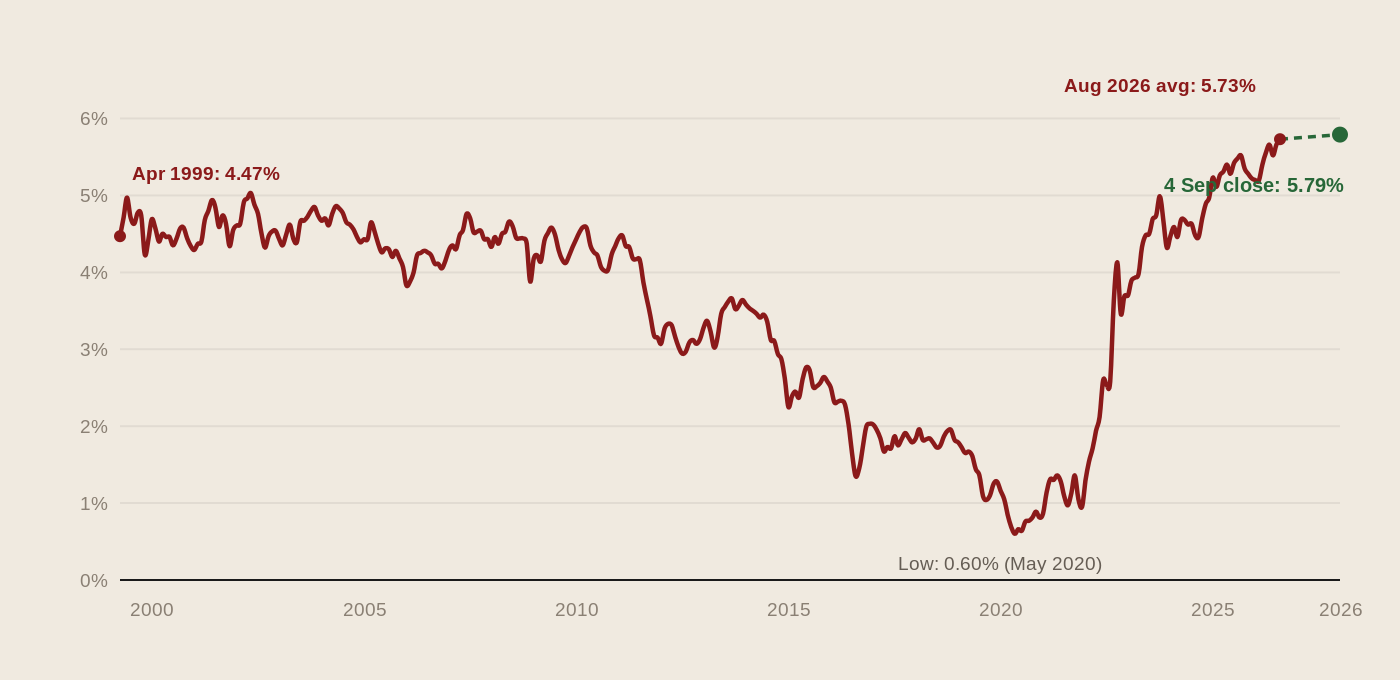
Source: UK Debt Management Office (report D4H), dmo.gov.uk. 30-year benchmark gilt yield, monthly average, April 1999–August 2026 (329 observations). Latest: August 2026, 5.73% — the series high. Marker: 4 September weekly close, 5.79%.
On the DMO's own monthly benchmark series, the 30-year gilt yield's August 2026 average of 5.73% is the highest in the 27 years since the series began in April 1999. The most recent weekly close, 5.79% on 4 September, sits higher still. Yields fell for two decades as quantitative easing did its work, bottoming at 0.60% in May 2020, before climbing steadily since 2022 through the mini-Budget, past every subsequent year's average, and now above where the series began.
|
|
Money & Credit
Money Supply Growth Slows; Consumer Credit Keeps Accelerating
|
M4ex Annual Growth
4.3%
|
Consumer Credit Growth
9.2%
|
Mortgage Lending Growth
3.6%
|
House Purchase Approvals
56,100
|
The Bank of England's July Money and Credit figures, published Tuesday, show the broader money-supply measure — M4ex — growing at an annual rate of 4.3%, down from 4.9% in June and now back within the range monetarists watch as consistent with the Bank's 2% inflation target. Consumer credit growth accelerated slightly to 9.2%, from 9.1% in June, driven by non-card borrowing such as car finance and personal loans (up to 7.7%) rather than credit cards (unchanged at 12.5%). Mortgage lending growth held at 3.6% even as approvals for house purchase fell to 56,100, the lowest since January 2024. Read together: households are still borrowing steadily on unsecured credit, but the housing market is losing momentum ahead of the Budget, and broad money growth is cooling rather than accelerating. Read GBTT's full analysis of the July Money & Credit data.
|
|
Energy
Hormuz Escalation Keeps The Squeeze On Bills
|
Brent Crude
~$95
|
Weekly Move
~+6%
|
Oct–Dec Price Cap
£1,723
|
A fresh US strike on Iranian oil tankers in the Strait of Hormuz this week pushed Brent crude up by roughly $5 a barrel on the week, to about $95, and European gas prices toward their highest since early 2023, with storage reported at unusually low levels for the time of year. None of this changes the £1,723 price cap Ofgem has already set for October to December — a 4% rise on the current quarter — but it does make the next review, covering January to March, harder to call. Households who assumed the worst of this year's energy shock was behind them should not assume that yet.
|
|
Gilt Markets & Sterling
Gilts Hold Near Their Highs; The Fed Adds To The Pressure
|
10-Year Gilt
5.16%
|
30-Year Gilt
5.79%
|
GBP/USD
1.351
|
FTSE 100
10,831
|
Governor Andrew Bailey argued this week that structural forces, not a temporary blip, are pushing government borrowing costs higher across advanced economies: weak productivity, an ageing population, the lingering fiscal legacy of Covid, and higher defence spending. Speaking at the London School of Economics' Trium conference, he called these “very, very substantial … structural challenges,” not simply a cyclical rise in borrowing. That is the backdrop to this week's gilt market: August's 5.73% average was the highest monthly reading in the DMO's 30-year benchmark series since it began in 1999, and the 30-year yield ended the week higher still. The 10-year yield rose too, flirting with 5.30%. New Federal Reserve chair Kevin Warsh's Jackson Hole warning that US inflation isn't beaten yet added to pressure on the dollar, nudging sterling lower over the week. Most economists still expect the Bank to hold Bank Rate on 17 September. The FTSE was little changed on the week.
|
|
Political Economy
O'Neill Warns Against A Capital Gains Raid; Retailers Take Aim At Business Rates
Lord O'Neill, a Conservative Treasury minister under David Cameron and Theresa May, warned this week that a capital gains tax raid in October's Budget would signal the government isn't “thinking about growth as sincerely as they claim,” and could prompt business owners to defer sales or shift money abroad rather than raise the revenue ministers hope for. Retailers including Tesco, Sainsbury's, M&S and Primark separately lobbied against a business-rates rise, arguing the sector already carries a disproportionate share of the total bill relative to its size. Both interventions land the same week analysts estimated higher gilt yields have already eaten into the Chancellor's headroom — a reminder that the arithmetic behind the 28 October Budget is getting harder from more than one direction at once.
|
|
Reform Conference
Jenrick Pitches Reform As The Party Of Fiscal Credibility With A £100bn Savings Plan
|
Welfare
£50bn
Largest single component of the plan
|
|
|
Departmental
£20–30bn
Across Whitehall departments
|
|
|
Debt Interest
£28bn
Assumed saving as borrowing falls
|
|
Robert Jenrick used Reform's Birmingham conference to set out a claimed £100bn-plus savings plan for the first 100 days of a Reform government — £50bn from welfare, £20–30bn from departmental budgets and £28bn from lower debt-interest costs — with an emergency Budget promised immediately after any election win rather than a drawn-out wait. He also wrote to major holders of UK government debt, including banks and pension funds, inviting them to a London and New York roadshow to pitch Reform directly to the people who buy gilts as “the party of fiscal credibility” — a striking move for a party not in government, and one that only makes sense against this week's gilt sell-off. Jenrick confirmed the details: a rise in the personal tax-free allowance to £15,000, alongside roughly £80bn of further spending cuts. Read GBTT's analysis of Reform's £15,000 personal allowance plan.
|
|
Westminster
Burnham Faces His First PMQs As Reform And Labour Run Level
|
Labour
23%
|
Reform UK
23%
|
Conservative
20%
|
Andy Burnham’s first Prime Minister’s Questions did little to dispel the impression that Labour’s new administration is still searching for a point. Badenoch pressed him repeatedly on how pledges such as scrapping VAT on electricity bills would actually be paid for; Burnham’s answers were long on words and short on anything resembling an answer. Even the Speaker was reduced to asking both sides to get to the point. The polling explains the nerves: YouGov has Labour and Reform level on 23%, with the Conservatives just behind on 20%. Burnham has a working majority, but so far not much of a governing argument.
Watch: Our Director, Damian Pudner, joined Mike Graham this week to discuss Burnham’s first appearance in Parliament — and why a lot of it amounted to little more than a word salad of nothingness. Watch the discussion on YouTube.
|
|
Global Context
The Tanker War Comes Back
The confrontation over the Strait of Hormuz escalated sharply this week. The US struck two Iranian government oil tankers under a new “tanker for tanker” retaliation policy, alongside attacks on roughly 100 Iranian military targets. Tehran responded with missile and drone attacks on US-linked facilities across Jordan, Bahrain and Iraq. The immediate economic consequence is obvious: a renewed risk premium in oil and gas, with the knock-on effect running straight into inflation expectations and global bond yields.
Separately, G20 finance ministers failed to agree a joint communiqué in North Carolina after China rejected language aimed at large trade surpluses and export-led growth. The other 19 members signed up. The argument over global imbalances — and the protectionist response they are provoking — is not going away.
|
|
Guest Opinion
This Week On gbtt.info
|
Healey Asked for Budget Ideas. Here's One: Abolish IHT
Ben Ramanauskas · Tax · 4 September 2026 · 5 min read
Inheritance Tax raises just 0.7% of UK tax receipts, yet a quarter of estates worth over £10m pay an effective rate below 9% while ordinary homes increasingly can't avoid it. Ramanauskas argues Britain should join the ten OECD countries that have already scrapped it.
|
|
Britain Is Selling Its Debt To The Wrong Market
Damian Pudner · CapX · 3 September 2026 · 6 min read
Britain's gilt buyer base has shifted from patient pension funds and insurers to price-sensitive hedge funds and foreign investors who won't hold long-dated debt through the cycle. Pudner argues the DMO should shorten issuance now, not defend a maturity structure built for a buyer base that no longer exists — noting Pantheon Macroeconomics estimates the Chancellor's fiscal headroom has already fallen from £23.6bn to around £13bn ahead of the Budget.
|
|
|
Pints & Policy
Next Week: We talk with David Starkey

GBTT's Pints & Policy returns next week with one of its biggest guests yet: historian Dr David Starkey. This will be a major conversation about the condition of Britain — its institutions, political class, governing culture and the long decline in standards across public life. Starkey is not known for pulling his punches, and neither is Pints & Policy. Release date to follow on gbtt.info. This is one not to miss.
|
|
The Week Ahead
GDP Day, Bailey Back In The Commons, And HMRC's Turn
| 1 |
Tue 8 Sep · 14:15 BST
Treasury Committee: Bailey And MPC Members
Andrew Bailey, Sir Dave Ramsden, Megan Greene and Alan Taylor face MPs on the Monetary Policy Report — the last public airing before the 17 September rate decision, and a chance to press Bailey further on the structural debt argument he made this week.
|
| 2 |
Wed 9 Sep · 14:15 BST
Treasury Committee: Work Of HMRC
HMRC chief executive John-Paul Marks gives evidence seven weeks before a Budget in which tax policy, not spending, looks set to do most of the work.
|
| 3 |
Fri 11 Sep · 07:00 BST
ONS GDP Monthly Estimate, July 2026
The big one: services, production, construction and trade all land together. Services make up around 80% of UK output and will drive the headline.
|
|
|
GBTT.
Data not vibes
Issue No. 17 · Sunday 6 September 2026 · gbtt.info
Sources: ConservativeHome, Bank of England, Reuters, UK Debt Management Office, S&P Global/CIPS, Ofgem, Bloomberg Economics, Reform UK, The Guardian, UK Parliament Treasury Committee, YouGov, Axios, gbtt.info, CapX, ONS.
Market data (Friday 4 September 2026): 10-year gilt 5.16%, 30-year gilt 5.79%, GBP/USD 1.351, FTSE 100 10,831. BoE base rate 3.75% (held 30 July, voted 6–3). Next MPC: 17 September 2026.
This briefing is for informational purposes only and does not constitute financial advice. © 2026 Great British Think Tank
|
|
