
|
| |
|
Editor's Note
Britain grew. Just. Cue the victory lap.
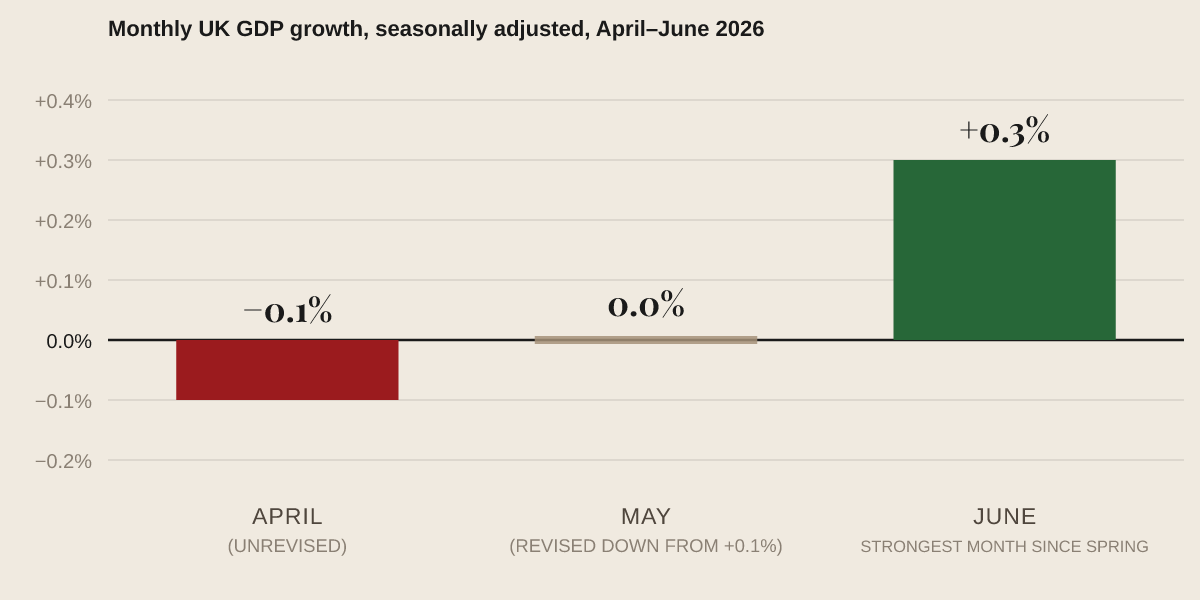
GDP rose 0.4% in the second quarter, down from 0.6% in the first — growth slowed by a third in three months. June did most of the rescuing, growing 0.3%; the ONS notes businesses cited the World Cup, warm weather and easing Iran-war energy costs as themes that month, though it's careful to say the effect can't be quantified. May was revised down to flat and April still shows a 0.1% contraction, unrevised. Ministers will remember June. They will develop convenient amnesia about the other two months of the quarter.
The state did less this quarter, even as households and businesses did more — and that split now has two live consequences, not one. Huw Pill told the Wall Street Journal on Thursday that stronger growth strengthens the case for higher rates, having already voted for one in July. And allies of the last Chancellor are warning the new one not to blow a "strong" inheritance on tax rises — a claim GBTT would treat with some scepticism, given the same £22bn gap Rachel Reeves once used is being quoted again.
Prime Minister Andy Burnham's government is not short of ambition, between spending pledges Cabinet was told there's no money for and a £9bn borrowing plan briefed weeks later. This week gave it a rates hawk arguing the economy can bear tightening, and its own side warning against spending the growth it has. Caution, not confidence, is the right read of a week that looked good in the headline number — and Clacton added its own footnote: Farage back in the Commons on a bigger majority and a shrunken turnout, the donations inquiry that paused when he resigned now resumed.
|
| |
|
GBTT News
The Great British Rebuild Is Live
A new section of gbtt.info launched this week.
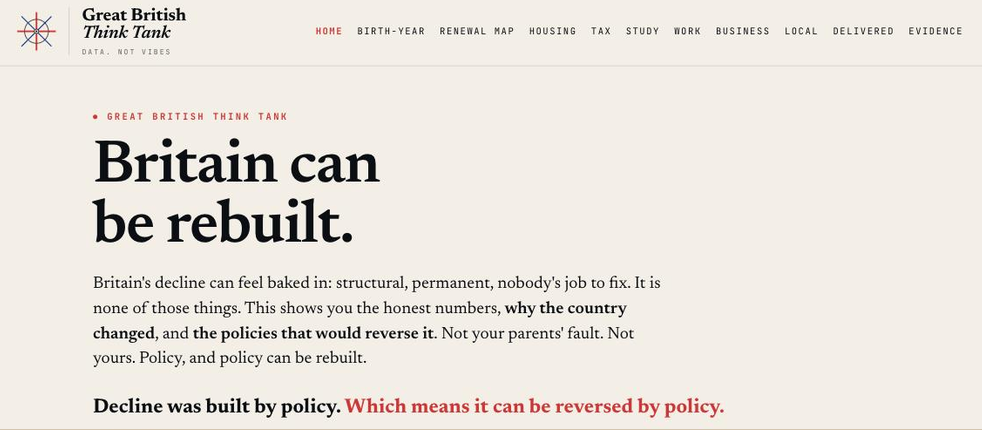
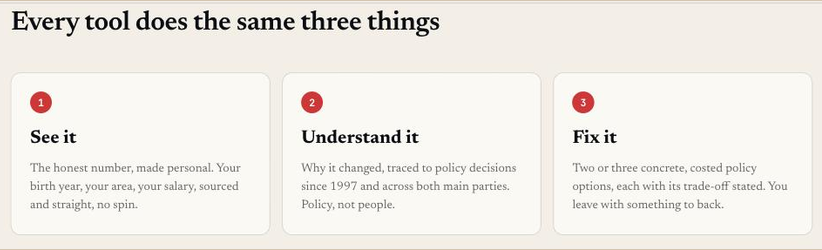
Britain's decline can feel baked in: structural, permanent, nobody's job to fix. It is none of those things. The Rebuild shows the honest numbers, why the country changed, and the policies that would reverse it — not your parents' fault, not yours. Decline was built by policy, which means it can be reversed by policy. Ten tools so far, from the Birth-Year Deal to the Affordability Gap, each doing the same three things: the honest number made personal, why it changed since 1997 across both main parties, and two or three costed options to fix it. Explore it at gbtt.info/rebuild.
|
|
|
|
gbtt.info/rebuild — see it, understand it, fix it.
|
| |
|
Coming Soon
GBTT Explainers
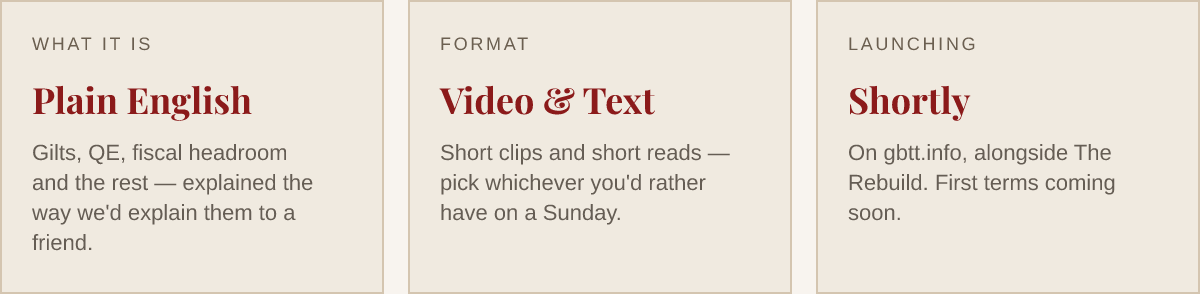
Straightforward explanations of the terms, policies and strategies behind the week's news — video and written, without the jargon.
|
|
| |
|
On Air
Damian On UKLive
Senior Research Fellow Damian Pudner joined Mark Littlewood and Paul Cox's morning show on UKLive this week.
|

|
|
|
| |
|
The Big Story
Britain Grew 0.4%. Westminster Has Already Spent It.
Days after the ONS confirmed the slowdown, allies of the last Chancellor started warning the new one not to squander an inheritance GBTT doesn't think is as strong as advertised.
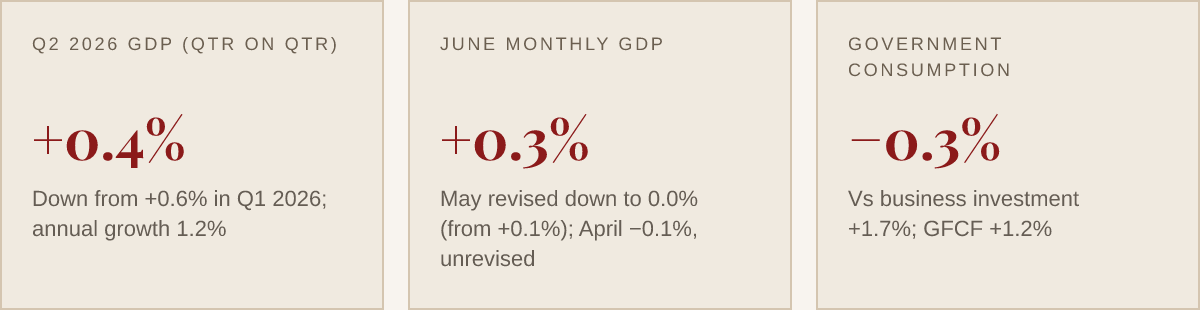
Thursday's ONS release confirmed what the Editor's Note already told you: 0.4% growth in the second quarter, down from 0.6% in the first, with June's 0.3% doing the work April and May didn't. The figures are below. What matters now is what Westminster does with them.
Household consumption rose 0.3% and business investment rose 1.7%, with gross fixed capital formation up 1.2%. Services grew 0.5%, construction 0.3%, production was flat. Government consumption — one part of the state's contribution, not the whole of it — fell 0.3%, on lower health and education spending.
|
|
|
That split now has a political echo. The FT reported this week that allies of Rachel Reeves are warning her successor, John Healey, against "blowing" a supposedly strong inheritance on further tax rises — Reeves did the tax-raising already, they argue. GBTT would treat "strong" with scepticism: the £22bn figure being quoted is the same one Reeves herself once used for what she'd inherited, and nobody briefing it this time has put a named calculation behind it.
The same day's trade figures fit the picture: the goods deficit widened to £60.7bn as imports grew faster than exports. None of this makes the reported £9bn/year borrowing proposal — still a plan, not announced policy — illegitimate on its own terms; but a Chancellor asking markets to trust new borrowing, while his own side warns against spending the growth he already has, is not asking from strength.
|
|
| |
|
The Bank
Huw Pill Isn't Done With Your Mortgage Yet
The Bank's chief economist looked at 0.4% growth, persistent inflation and decided Britain could probably take another rate rise. Three MPC members now want a rise.
|

|
|
Huw Pill, the Bank of England's chief economist, told the Wall Street Journal on Thursday that stronger-than-expected GDP data reinforces the case for higher borrowing costs. If markets increasingly price that rate path, it puts upward pressure on new fixed mortgage rates too. Pill was one of three dissenters — with Megan Greene and Catherine Mann — in July's 6–3 vote to hold Bank Rate at 3.75%, up from two dissenters in June and one in April; the hawkish minority has widened at each of the past three MPC decisions. "This goes in the direction of reassuring me that we're not entering a sharp downturn," Pill said, adding that in nearly five years on the MPC, inflation has been at or below target for only three months.
|
| |
|
Westminster
Farage Wins. So Does Count Binface.
Nigel Farage took 63%. Count Binface took 27%. Britain's major parties took the afternoon off.
|

|
|
Farage resigned on 8 July, while the Parliamentary Commissioner for Standards was still investigating an undeclared £5m gift flagged by bankers as potentially laundered money — a case that could yet be referred to the Standards Committee; he denies wrongdoing. His resignation paused the inquiry, and his return allows it to resume. Labour, the Conservatives, the Lib Dems and the Greens all declined to contest, leaving novelty candidate Count Binface — who took 26.9% of a record 34-name field — as the only real protest vote on offer. Farage's majority rose by roughly half, to 12,784; turnout fell 14.3 percentage points, from 58.7% to 44.4%. Reform is not currently leading the polls — YouGov's 9–10 August reading had Labour 24%, Reform 22%, the Conservatives 21% — but it remains squarely competitive, and its 1,451 council-seat gains in May's local elections suggest Burnham's honeymoon was always going to be short-lived. The more interesting story is what a boycotted by-election says about the parties who chose not to show up.
|
| |
|
The Channel
Fewer Boats, Much Bigger Loads
Just 11 boats reached Britain this week, carrying 1,004 people between them — an average of 91 per vessel, including a record 230 in one boat on Monday.
|

|
|
Home Office figures show 258 people crossed on Saturday, 423 on Sunday, then a record 230 in a single boat on Monday — more than 20 of them children, French officials say; nobody crossed Tuesday to Thursday, and 93 arrived Friday. That's a record boat, not a surge in numbers: arrivals in the first seven months of 2026 ran 44% below the same period in 2025 (14,200 versus 25,436, Home Office), and this week's tally doesn't reverse that trend. But the boats keep growing — a 165-person crossing in July, then a dinghy carrying 173 people that capsized after its engine caught fire off Boulogne on 4 August, now Monday's 230. Enforcement appears to be cutting the number of boats leaving France; smugglers have answered by loading more people onto the ones that do. Ministers point to a new 24-week target for certain asylum and immigration appeals, in force since Wednesday, as the answer on the exit side of the system.
|
| |
|
Chart of the Week
June Saved The Quarter
April −0.1%. May 0.0%. June +0.3%. That's the recovery ministers will be selling you. The quarter still slowed.
|
|
|
UK monthly GDP growth, seasonally adjusted, April–June 2026. May's figure is revised down from an initial +0.1%; April is unrevised. Quarterly growth for Q2 2026 as a whole was +0.4%, down from +0.6% in Q1 2026. Source: ONS, GDP first quarterly estimate, UK: April to June 2026, released 13 August 2026.
|
|
A rebound in the last month of a quarter is good news. It is not the same as a quarter that accelerated.
|
| |
|
Property
Housing Has Stopped Getting Worse. That's Not The Same As Getting Better.
Buyer demand and agreed sales are stuck exactly where they were in June. Surveyors think prices might eventually rise. Almost everything happening before then says otherwise.
|

|
|
RICS's July Residential Market Survey, published Thursday, shows new buyer enquiries at a net balance of −28% — a net balance is the gap between surveyors reporting rises and those reporting falls, not a share of the market — unchanged from June but well up from March's −41% low. Agreed sales held at −30%, an improvement on April's −37%. Twelve-month price expectations remained positive at +4%, but eased from +8% in June — London's outlook fell sharply over the same period, from −10% to −23%, one of the weakest regional readings. RICS chief economist Simon Rubinsohn said geopolitics, domestic politics and mortgage costs continue to weigh on sentiment; one lender pointed to October's Budget as a reason buyers are waiting.
|
| |
|
Markets, Energy & Gilts
Five Per Cent Gilts Are Back
Ten-year and thirty-year gilt yields both rose double digits in basis points this week — meaning gilt prices fell — as markets digested Pill's rate comments alongside the GDP data.
|

|
|
The 10-year gilt finished the week at 5.05%, up 12 basis points. The 30-year hit 5.82%, up 15. Westminster can talk about the reported £9bn borrowing plan in whatever accounting language it likes. The people lending it the money have their own language. It's called price. Thursday's stronger-than-expected GDP data and Pill's rate comments (see The Bank) fed into the move. The FTSE 100 closed at 10,750, down 1.4% on the week — its first weekly fall in five weeks, led lower by mining stocks. Brent futures settled at $88.52, up about 6% on the week, as the US signalled it could maintain its naval blockade of Iran indefinitely (see The Gulf). Sterling was similarly little changed on the day at $1.3521, up around 0.3% on the week.
|
| |
|
The Great EV Retreat
Three Years Of EV Certainty. Now Whitehall Wants Another Think.
Manufacturers were told to plan for 80% electric sales by 2030. The Government is now consulting on 70%, 60%, 50%, or keeping 80% and making it easier. Certainty, Westminster-style.
The Zero Emission Vehicle mandate already requires 33% of new cars sold this year to be zero-emission, rising to 80% by 2030; the consultation, open until 23 October, examines the alternatives above — 50% is one option under review, not a preferred new target. The Government says the 2035 destination, all new cars and vans zero-emission, is unchanged. Manufacturers have spent three years planning investment around the existing targets; less pressure to hit quotas by discounting could mean fewer cheap electric models on forecourts, not more.
|
| |
|
The Gulf
So Much For De-Escalation
Nearly six months into the war, the US said Thursday it could maintain its naval blockade of Iran indefinitely. That's a harder line than the transit-fee haggling suggests, and it's the actual story now.
The war that began in February is now nearly six months old. Iran says the Strait of Hormuz stays closed until the US blockade and sanctions lift, frozen Iranian assets are released and reparations paid; the US said Thursday it is prepared to hold its blockade indefinitely and increase economic pressure instead. Houthi forces, aligned with Iran, claimed an 11 August attack on the cargo vessel Tihamah in the Bab al-Mandeb strait that killed six. The argument over a 3% or 7% transit fee — Iran wanted 5–7%, Oman offered 3% — suddenly looks rather quaint next to an indefinite blockade. Brent crude was still up on the week regardless (see Markets, Energy & Gilts) — a reminder that oil prices move on demand and inventory signals, not just Gulf headlines. For UK households, Ofgem must confirm the October–December price cap by 26 August — the first real test of how far this year's oil and gas moves reach household bills.
|
| |
|
Drought & Farming
Defra Finds £65m For Drought. It Was Already There.
England and Wales just had their driest July on record; almost three-quarters of England is now officially in drought. Burnham's answer, announced late Friday ahead of a farm visit Saturday, was £65m.
|

|
|
The package adds £50m to the Sustainable Farming Incentive, taking its 2026 budget to £290m, and up to £15m for on-farm reservoirs, with farmers in environmental schemes given more flexibility to graze drought-hit land without losing payments. The Government has confirmed the money is reprioritised from Defra's existing farming budget, not new spending — shadow Defra secretary Victoria Atkins says that comes alongside a £100m cut to the department's wider farming budget. Britain's cereal harvest is reportedly on course to be the worst since comparable records began in 1984 (Reuters). Burnham calls food production a matter of national security. On that, at least, he has a point.
|
| |
|
Further Reading
From GBTT This Week
The Missed Departure: Britain's Fragmented Aviation Policy
Mark Atherley · Aviation, Policy · 13 August 2026 · 7 min read
Britain can build a jet engine. Apparently an aviation policy is harder. Atherley's complaint: Air Passenger Duty raised £4.5bn in 2025–26, and none of it is ring-fenced for decarbonisation.
This Beef Ban Stinks of Protectionism
Ben Ramanauskas · Trade, Brexit · 11 August 2026 · 4 min read
Brazilian beef, EU rules and a familiar smell of protectionism. The EU excludes Brazilian beef from 3 September unless Brazil can show new antibiotic-monitoring compliance; the NFU wants Britain to follow suit if Brazil can't demonstrate compliance. Ramanauskas isn't convinced either is about food safety.
|
| |
|
Next Week
Next Week's Trouble
| 1 |
Tue 18 Aug · 07:00 & 09:30 BST
ONS Labour Market Overview (07:00) + Productivity Flash (09:30)
|
|
| 2 |
Wed 19 Aug · 07:00 BST
ONS CPI + Producer Prices, July 2026
June's reading was 2.6%.
|
|
| 3 |
Fri 21 Aug
ONS Public Sector Finances, July 2026
The first hard borrowing number since the Treasury's £9bn headroom story broke.
|
|
Also out Friday 21 August: Retail Sales (July) and the flash August PMI (readings above 50 signal expansion, below 50 contraction).
|
| |
|
GBTT.
Data not vibes
Issue No. 14 · Sunday 16 August 2026 · gbtt.info
Sources: ONS, Bank of England, RICS, Tendring District Council/UK Parliament, DfT/GOV.UK, Ofgem, HMRC, Home Office, Defra, NFU, YouGov, Reuters, Financial Times, Wall Street Journal, MarketWatch, GBTT.
Market data: Friday 14 August 2026 — 10-year gilt 5.05%, 30-year gilt 5.82% (both MarketWatch, confirmed); Brent futures $88.52 (ICE, Friday settlement); GBP/USD $1.3521 is a late-Friday-afternoon snapshot, not a close (FX trades continuously); FTSE 100 10,750 (confirmed close). Prior Friday, 7 August: 10-year gilt 4.93%, 30-year gilt 5.67%, Brent $83.55, GBP/USD $1.348, FTSE 100 10,901.
|
|
