GREAT BRITISH
THINK TANK |
GBTT.
Weekly Briefing
|
DATA NOT VIBES
gbtt.info |
|
|
|
SUNDAY 9 AUGUST 2026 · ISSUE NO. 13
|
|
Editor's Note
A campaign group's tracker put Britain's national debt above £3 trillion this week, ahead of the OBR's forecast. Days later, the Treasury let it be known it wants to borrow even more.
The £3tn figure comes from the TaxPayers' Alliance, not the ONS — the official total stood at £2.99tn at the end of June, with the OBR not expecting the threshold before September. A joint Healey/Burnham letter, reported in late July, told Cabinet colleagues there is no new money for Burnham's own spending pledges and that departments should prepare cuts. Then, on Wednesday, the Times reported the Treasury is exploring greater use of the balance-sheet fiscal rule; the Resolution Foundation estimates that could create scope for around £9bn a year of additional investment by 2031.
Citi's chief UK economist warned back in October 2024 that gilts faced a "buyers' strike" risk if government borrowing for investment surged, given how reliant Britain is on foreign buyers to absorb its debt. That warning was written about Rachel Reeves; it reads just as well about her successor — and on Saturday, Bloomberg reported that Treasury officials now share it, worried investors will read Burnham's promise to use "any flexibility" in the fiscal rules as a constraint with no actual limit. None of this makes investment borrowing wrong in principle — the distinction between capital and current spending is real. It does mean Healey is asking markets to trust a new borrowing ambition in the same fortnight as a £3 trillion headline and a letter telling his own colleagues there's nothing left. The Budget, on 28 October, is where that trust gets tested — until then, the Treasury calls it headroom. The gilt market may use a different term.
Elsewhere, Cambridge supplied the week's other lesson in institutional competence: deconstructing "whiteness" appears to have been rather easier than conducting due diligence.
|
|
GBTT Pints & Policy
Episode One Is Live
GBTT's new podcast series launches this week — same "data not vibes" brief, now in conversation. The first episode had no-nonsense opinions from the exceptional City commentators, Marcus Ashworth (formerly of Bloomberg Opinion) and Michael Brown.
|
|
The Big Story
Britain's Debt Hits £3 Trillion On One Estimate — And The Treasury Wants To Borrow Even More
A campaign group says the milestone has already arrived, ahead of the OBR's own forecast. Days later, the Treasury began exploring how to borrow more.
TaxPayers' Alliance estimates put UK national debt past £3 trillion in early August — a tracker, not an ONS release. The confirmed figure was £2.99tn at the end of June. Debt-to-GDP is now about 95%, against roughly a third in 2004/05. The first £1tn was reached in 2010; the second followed ten years later; the third has taken six.
Debt interest is projected at £109.4bn in 2026/27 — around 1.6 times the entire Ministry of Defence budget. The Debt Management Office already plans £252.1bn of gilt sales in 2026/27, including refinancing maturing debt.
Against that backdrop, Treasury officials are exploring greater use of the balance-sheet fiscal rule, with the Resolution Foundation estimating scope for around £9bn a year of additional investment by 2031. Borrowing in the financial year to June was already £57.6bn — £2.7bn above the OBR's forecast profile.
|
Debt (TPA Tracker)
~£3.0 tn
ONS: £2.99 tn at end-June
|
Planned Gilt Sales
£252.1 bn
2026/27 gross issuance
|
Debt Interest
£109.4 bn
~1.6x the MoD budget
|
|
|
Chart of the Week
England Got Just 10% Of Its Normal July Rainfall
The driest July in England's record is no longer just a weather story. Reservoirs are falling, crop yields are being cut and the next food-price shock may already be growing in Britain's fields.
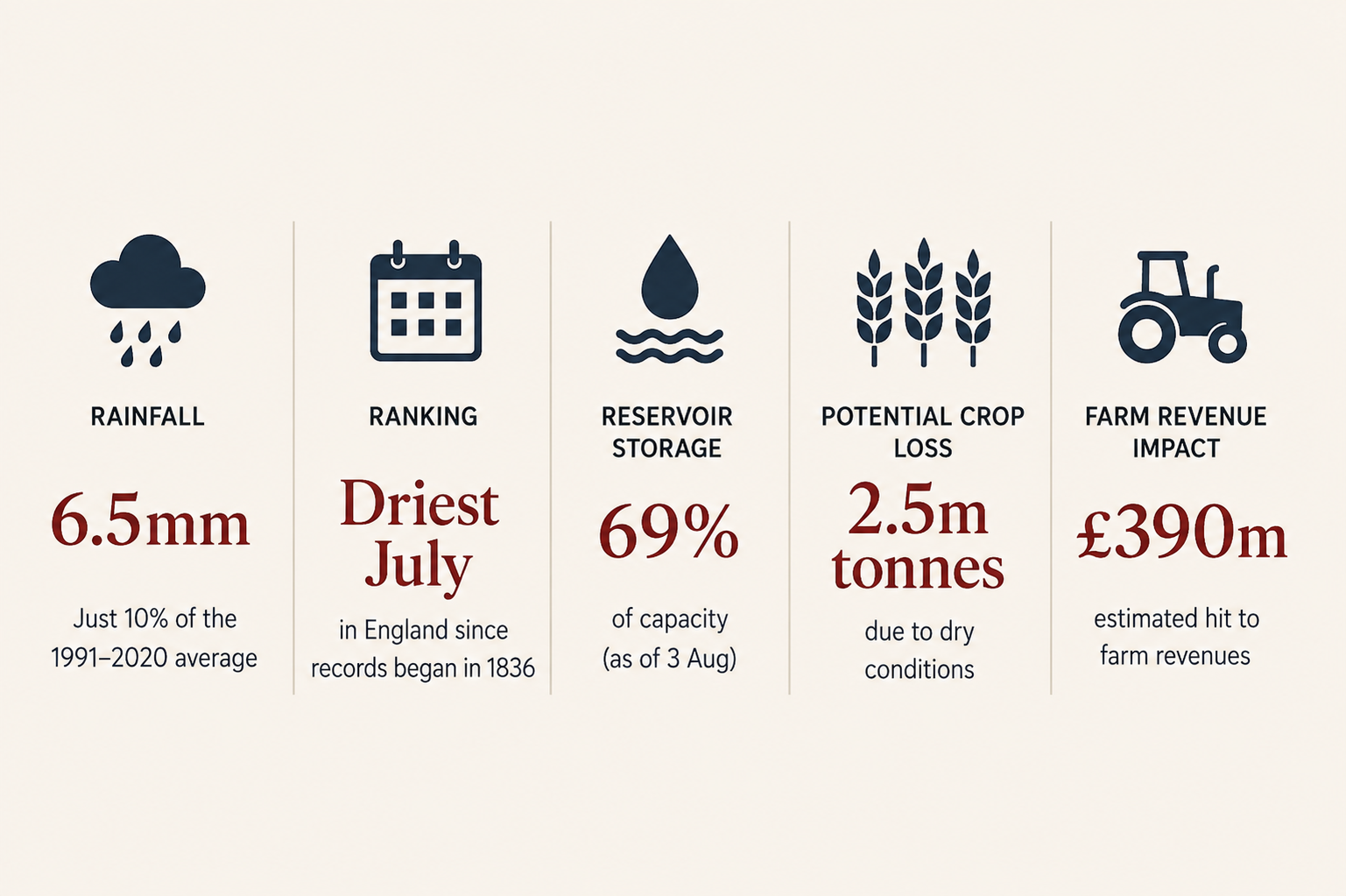
The economic risk is food inflation. Analysis cited by Reuters estimates that the 2026 cereal and oilseed harvest could be the weakest in records dating to 1984. Imports can cushion domestic shortages, but with energy and fertiliser costs still exposed to the Gulf, another supply-side inflation shock is no longer remote.
|
|
Housing
House Prices Have Stalled. For Flats, It Is Worse.
Nationwide and Lloyds show a housing market barely moving. Beneath the national averages, England's flats market is suffering something more serious: liquidity is disappearing.
|
Nationwide, July
£277,542
+0.1% month; annual growth eased to 1.8% from 2.2%
|
Lloyds, July
£299,253
Flat month; annual growth 0.1%, weakest in almost three years
|
Leasehold Flats Unsold
80.5%
Still unsold after six months; Zoopla analysis of 2025 listings across most of England
|
The headline indices mask a much sharper split underneath. Zoopla data reported by the Guardian show that 80.5% of leasehold flats listed across most of England in 2025 had not sold within six months. In London the figure was 87%, followed by the South East at 85% and the East of England at 84%.
|
London Flats Unsold
87%
|
House Prices Since 2016
+43%
|
Flat Prices Since 2016
+10%
|
Avg 2-Yr Fixed Mortgage, Now
5.63%
|
The divergence has been building for years. Across the UK, Zoopla says house prices are up 43% since 2016 while flats have risen only 10%. Leasehold uncertainty, service charges, ground rents, cladding and costly lease extensions have all weakened demand. Mortgage restrictions and surveyors down-valuing flats are narrowing the buyer pool further.
That matters because flats are the entry point for many first-time buyers, particularly in London. Yet investor-owned flats are often being offered above first-time-buyer budgets, while the average two-year fixed mortgage rate has risen from 5.54% to 5.63% in under three weeks.
Sources: Nationwide; Lloyds Banking Group; Moneyfacts; Zoopla analysis reported by the Guardian, 8 August 2026.
|
|
Economy
Growth Came Back In July. Jobs Didn't.
Twenty-two months of falling surveyed private-sector employment has now matched the length of the 2008 financial crisis slump — even as the survey data on activity turned up.
|
Services PMI
52.1
|
Composite PMI
52.2
|
Construction PMI
44.7
|
Manufacturing PMI
51.9
|
Retail Footfall, Jul (YoY)
−2.1%
|
Services PMI didn't just recover in July, it leapt — from 48.8 to 52.1 in a single month, dragging the composite reading to 52.2 and back into growth for the first time since April (above 50 means expansion, below 50 contraction). Manufacturing held its ninth straight month of growth; construction, still shrinking at 44.7, is at least shrinking more slowly. None of it stopped the PMI employment indices signalling private-sector job cuts for a 22nd straight month, a run now as long as the entire 2008-09 slump. A rebounding survey is not a rebounding jobs market, and jobs are what voters actually feel.
|
|
Business & Growth
Citi's Warning: Money Votes With Its Feet
Citi chief executive Dame Jane Fraser delivered a blunt warning on Britain's tax burden and its appeal to international capital.
|
UK Bank Tax Burden
~48%
|
New York
~27%
|
The Times puts the UK tax burden on banks at roughly 48%, against about 27% in New York and 28–29% in Dublin. That is a gap of around 20 percentage points: the UK burden is roughly 78% higher than New York's and around 66–71% higher than Dublin's. Dame Jane Fraser’s warning was therefore more than rhetoric: “money votes with its feet”. Citi can deploy capital, people and balance sheet across jurisdictions, and tax is part of that calculation. Her wider judgement was equally uncomfortable: Britain is viewed from the US as “a bit diminished from what it used to be”. For a government that says growth is its overriding priority, that should matter rather more than another slogan about competitiveness.
|
|
Markets, Energy & Gilts
A Weak US Jobs Report Moved Markets More Than The Gulf Did
What actually moved gilts and the dollar on Friday was a surprisingly weak US jobs report.
|
10-Year Gilt
4.93%
|
30-Year Gilt
5.67%
|
Brent Crude
$83.55
|
GBP/USD
$1.348
|
FTSE 100
10,901
|
US non-farm payrolls unexpectedly fell 23,000 in July, pulling Treasury and gilt yields lower and weakening the dollar — a bigger driver of Friday's UK market moves than anything happening in the Gulf. Ten-year gilts ended the week at 4.93%. Brent settled at $83.55 after a volatile week dominated by on-off Hormuz negotiations, while the FTSE 100 closed at 10,901. The combination leaves the UK with an awkward mix: softer global demand signals, but continued energy-price risk.
|
BoE Gilts Unwound Since 2022
~£300bn
|
EY Hormuz Scenarios, 2027 UK GDP Growth
−0.2% to +1.2%
|
|
|
Further Reading
This Week on gbtt.info
What if Britain had never privatised water?
GBTT Research · What If? · 5 August 2026 · 11 min read
Water was handed to shareholders debt-free in 1989. Since then they've taken out roughly £85bn in dividends, the companies have run up about £60bn of debt, and bills just rose 26% in a year — publicly-owned Scotland charges about £115 a year less for the same service.
Debt in Every Postcode
Guest Contributor Graeme Orchard · Economy · 6 August 2026 · 4 min read
A guest take on this issue's own lead story: Healey's exploration of £9bn more borrowing is, in this contributor's view, the same wager Rachel Reeves made — "the same dice on the same failed wager, only this time with the car keys and the deeds to the house on the table."
Are linkers a good deal for taxpayers?
Damian Pudner · CapX · 6 August 2026 · 5 min read
Britain has issued more index-linked debt than any other G7 economy — a quarter of the gilt portfolio, roughly twice the next most exposed country. Historical savings of £86.9bn, the DMO's own figure, don't by themselves justify selling inflation insurance at the same scale going forward.
|
|
Next Week
Three Things to Watch
| 1 |
Tue 11 Aug
BRC-KPMG Retail Sales Monitor (July)
The first read on retail spending.
|
| 2 |
Thu 13 Aug · 07:00 BST
UK Q2 GDP — First Estimate, Plus June GDP
Not just June's monthly figure — this is the first official read on whether the economy grew or shrank in the second quarter, the week's most consequential release, three months out from a Budget already short of room.
|
| 3 |
Thu 13 Aug · 07:00 BST
UK Trade in Goods (June 2026)
Published alongside GDP.
|
|
|
GBTT.
Data not vibes
Issue No. 13 · Sunday 9 August 2026 · gbtt.info
Sources: ONS, Bank of England, OBR, Debt Management Office, HM Treasury, Met Office, Environment Agency, TaxPayers' Alliance/City AM, S&P Global/CIPS, Nationwide, Lloyds Banking Group, Moneyfacts, Zoopla, BLS, EY, BRC, Financial Times, Bloomberg, Reuters, The Times, The Guardian, The Telegraph, Trading Economics, Resolution Foundation, GBTT.
Market data: Friday 7 August 2026 close — 10-year gilt 4.93%, 30-year gilt 5.67%, Brent crude $83.55, GBP/USD $1.348, FTSE 100 10,901. The £3tn national debt figure is a TaxPayers' Alliance tracker estimate, not an official ONS release — the confirmed ONS figure is £2.99tn at end-June 2026, next update 21 August 2026.
|
|
