|
GREAT BRITISH THINK TANK
|
|
GBTT.
WEEKLY BRIEFING
|
|
|
|
SUNDAY 2 AUGUST 2026 · ISSUE No. 12
|
|
EDITOR'S NOTE
|
|
John Healey has announced the date of the Budget. Wednesday 28 October will be the earliest Autumn Budget since 2021, chosen — we are told — to end the speculation over who will pay for the Government’s promises. That was the theory. In practice, fixing the date merely gave everyone a deadline by which the Chancellor must explain the arithmetic he has so far preferred not to discuss.
The timing was not especially kind. The same week brought a war spreading onto Egyptian territory, fresh attacks on US forces in Jordan, direct US strikes on Iran, and a Bank of England where the minority demanding higher rates has grown from two members to three. The message from Threadneedle Street is becoming harder to ignore: inflation risks have not gone away, even if the majority is still prepared to wait.
Then there's the £850 million electricity VAT cut, supposedly funded by cancelling an unfunded scheme. That is certainly imaginative. Whether the Treasury can spend the same missing money twice is presumably one of the details being saved for October.
Politics offered little more comfort. Labour held Greater Manchester comfortably, but only one voter in four could be bothered to turn up. Clacton will tell us whether that indifference is local — or merely spreading.
None of this constitutes a fiscal crisis. Gilts were broadly steady, equities reached another record and Healey still has room to act. Markets are not endorsing the Government's arithmetic. They are simply reserving judgment until 28 October. The Budget is no longer just another fiscal event. It is the first serious test of whether this Government's promises can survive contact with the numbers.
And while Westminster wrestles with £22bn fiscal holes, my local Wetherspoons has quietly raised a pint by 11p. This one, at least, has been fully costed.
|
|
THE BIG STORY
|
|
The Budget date is set. The funding is not.
Healey has fixed 28 October to control the narrative on tax and spending. This week supplied three separate reasons why the narrative may end up controlling him instead.
The fiscal starting point remains the one set out last week: borrowing in the first three months of the financial year was £57.6bn, £2.7bn above the OBR's forecast profile. Last week's claim that the £850m electricity VAT cut would be funded by cancelling digital ID also came under renewed scrutiny, after Darren Jones pointed out that the programme had never been specifically funded in the first place.
The Budget will also have to reckon with a bigger structural change moving alongside it. Prime Minister Burnham confirmed this week that English mayors will retain a share of locally raised business rates from spring 2027 and a share of income tax from 2028, replacing the ring-fenced grants that currently fund local projects. It does not change what anyone pays in tax — only how the revenue is split between Westminster and town halls — but it is a genuine transfer of fiscal power, and the Government has yet to say what proportion mayors will keep.
Ten-year gilts ended the week at 5.07% and thirty-year gilts at 5.78%, little changed despite the hawkish MPC vote and renewed escalation in the Gulf. The market is not panicking; nor is it offering Healey cheap room for manoeuvre. Any genuine funding gap will now have to be financed against a materially higher marginal cost of borrowing.
|
| FISCAL HOLE (CITY AM EST.) |
£22bn+ |
| NIESR REVISED 2026 GROWTH |
1.1% |
| NIESR: INFLATION BACK TO TARGET |
Not Until 2029 |
|
|
City AM's £22bn is a press estimate, not an OBR or Treasury figure — Healey has not confirmed it. NIESR raised its 2026 growth forecast from 0.9% this week, but pushed its inflation-to-target date back to 2029, blaming higher energy prices resulting from the conflict. Stronger growth and stickier inflation is not a combination that makes a Chancellor's arithmetic easier.
|
|
A tax cut funded by a saving nobody can find is not fiscal flexibility.
|
|
CHART OF THE WEEK
|
|
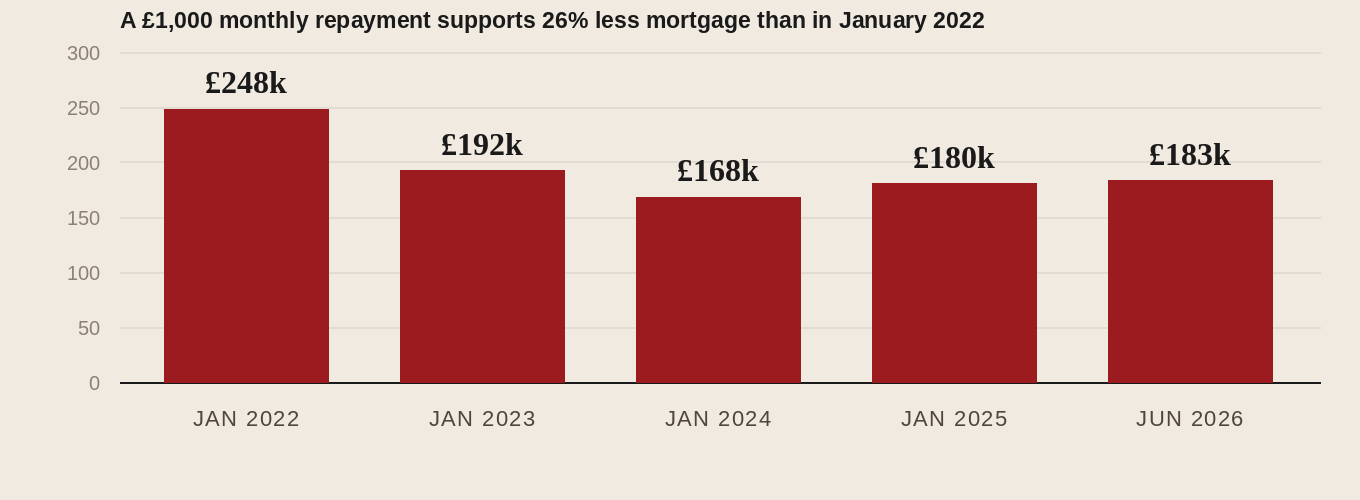
£1,000 a Month Now Buys 26% Less Mortgage
House prices barely moved in three and a half years. Repayment-supported borrowing capacity has fallen.
|
|
|
Illustrative 25-year repayment mortgage supported by a fixed monthly repayment of £1,000. GBTT calculation using Bank of England effective interest rates on new secured mortgage lending, observations Jan 2022, Jan 2023, Jan 2024, Jan 2025 and Jun 2026 (latest available). Average UK house price: HM Land Registry/ONS UK House Price Index, May 2026 provisional data vintage — Jan 2022 £274,000, May 2026 £271,295 (+2.7% annual growth).
|
| LESS BORROWING POWER |
£65,000 |
| VS JAN 2022 |
−26% |
| AVG HOUSE PRICE, JAN 2022 |
£274k |
| AVG HOUSE PRICE, MAY 2026 |
£271k |
|
|
The arithmetic shows what higher mortgage rates have done to repayment-supported borrowing power. A fixed £1,000 monthly payment supported an illustrative £248,000 mortgage in January 2022; by June 2026 it supported £183,000 — 26% less. Over broadly the same period, the average UK house price barely moved, from roughly £274,000 to £271,000.
|
|
THE BANK OF ENGLAND
|
|
Three votes for a hike
The Bank held rates again on Thursday. Three MPC members wanted Bank Rate raised to 4%. September’s QT decision may matter almost as much for gilt yields.
3.75%
Bank Rate held for a fifth consecutive meeting.
The Monetary Policy Committee voted 6–3 to hold Bank Rate at 3.75% on Thursday. Megan Greene, Catherine Mann and Huw Pill voted for a quarter-point rise to 4%. Bailey told reporters the Committee was "not getting closer to a hike" despite the growing dissent, pointing to CPI inflation's fall to 2.6% in June. But he also flagged that energy prices remain "high and volatile" because of the war in the Middle East — precisely the risk that pushed three colleagues to vote the other way. The next decision is 17 September.
QUANTITATIVE TIGHTENING
|
| CURRENT QT PACE |
£70bn/yr |
| EXPECTED FROM OCT |
£50bn/yr |
| ADDED TO 10-YEAR YIELDS |
20–30bp since 2022 |
| DECISION DUE |
17 Sep |
|
|
Markets now expect the Bank to slow its gilt-reduction programme from £70bn to £50bn a year from October, to be decided at the September MPC — and the Bank's own latest estimate is that cumulative QT has already added 20–30 basis points to 10-year gilt yields. A slower pace of sales would ease some of the upward pressure on the very yields that make Healey's own borrowing more expensive — a material lever on the Government's debt costs, alongside anything likely to be announced at the Budget itself.
|
|
MONEY & CREDIT
|
|
The credit surge that isn't one
June's headline lending number looks like a boom. It isn't — read on for where the real story is.
|
|
MONEY
Annual money supply (M4ex) growth accelerated to 5.0% in June from 4.8% in May, marginally above the latest annual growth in nominal GDP (4.4%). Bank staff analysis, cited by Breeden and Pill, found neither a broad-money overhang nor a clear upside inflation signal from recent monetary developments. That conclusion may prove right. But the renewed acceleration deserves closer attention than it is currently getting.
|
|
|
Wednesday’s Money and Credit release put some flesh on that number — and made clear why the headline needs treating with care. M4Lex lending jumped by £39.1bn in June, which at first glance looks like the start of a credit boom. It was nothing of the sort.
Almost three quarters of the increase came from pension funds, insurers and other non-bank financial firms, which swung from a revised £6.9bn of net repayment in May to £28.5bn of net borrowing in June. That is financial-sector volatility, not Britain’s households and businesses suddenly rediscovering their appetite for debt.
Strip it out and the picture is better, but much less dramatic. Household borrowing rose to £7.9bn from a revised £4.5bn, while private companies borrowed £2.7bn against £2.3bn in May. There is some genuine improvement in there. A boom it is not. GBTT’s full data release, linked below, is worth reading.
|
| Money Supply (M4ex) GROWTH |
5.0% |
| NET MORTGAGE BORROWING |
£7.7bn |
| CONSUMER CREDIT GROWTH |
9.1% |
| MORTGAGE APPROVALS |
58,200 |
|
|
Source: Bank of England Money and Credit, June 2026 (published 29 July 2026); GBTT Data Release, 29 July 2026. M4ex and consumer credit figures are annual growth rates; mortgage borrowing is the monthly net flow.
|
|
Mortgage borrowing picked up during the month — net lending jumped to £7.7bn from a revised £3.3bn in May, and approvals rose to 58,200, though still below their six-month average. None of it came cheap though: the effective rate on new secured mortgage lending rose to 4.35% from 4.22%.
10,600–10,800
Taylor Wimpey supplied the real-economy counterpoint. It trimmed its 2026 completions guidance to 10,600–10,800 homes, from 10,600–11,000, and slashed the interim dividend by 74% to 1.20p. Stretched affordability, geopolitical uncertainty and rising build costs are colliding with the Government’s housebuilding ambitions.
|
|
|
|
MARKETS & ENERGY
|
|
BP Puts Six Decades in the North Sea Up for Sale
BP has put its UK North Sea business up for sale after six decades of production — the bigger structural story this week, even as an unclaimed attack in Egypt and confirmed strikes on Jordan and Kuwait moved the oil price.
|
| 10-YEAR GILT |
5.07% |
| 30-YEAR GILT |
5.78% |
| BRENT CRUDE |
$90.17 |
| GBP/USD |
$1.345 |
| FTSE 100 |
10,868 |
|
|
A drone struck a gas storage vessel at Egypt’s Damietta port on Wednesday, setting it ablaze and spreading fire to a second vessel. Egypt confirmed the attack on Thursday; no party has claimed responsibility and the investigation remains open. The incident followed an Iranian missile attack on US forces in Jordan on Tuesday. American strikes on dozens of Iranian military targets then began at midnight UK time on Thursday and continued for two hours.
Brent settled at $90.17 on Friday, up 1.2% on the day. Oil feeds quickly into fuel, freight and production costs; household bills depend more directly on wholesale gas and electricity. Ofgem is due to publish the October price cap by 26 August.
Gilts and sterling took it largely in their stride. Ten-year yields closed at 5.07% and GBP/USD at $1.345, both close to where they began the week. The FTSE 100 touched another intraday record of 10,989 on Friday before easing to 10,868 — still up 1.2% over the week, despite Thursday’s hawkish MPC vote.
BP supplied the more uncomfortable signal. It has put its entire UK North Sea business — six decades of production, around 1,100 jobs and five production hubs — up for sale. Whatever BP’s internal reasons, when a major operator decides Britain’s basin is better sold than developed, it is reasonable to ask what the tax regime and energy policy look like from inside the industry.
|
|
BRIEFLY
|
|
Two Numbers That Tell Their Own Story
ARGOS
£1.1bn in. £120m out.
Sainsbury’s has found a buyer for Argos — and a rather expensive answer to a ten-year experiment. Bought in 2016 for £1.1bn, the business is being sold to Swift Partners for at least £120m, alongside a £350m non-cash impairment. The deal covers 201 standalone stores and 466 concessions inside Sainsbury’s, with completion expected in February 2027. After a decade spent trying to bolt general merchandise onto groceries, Argos is changing hands for roughly a tenth of what Sainsbury’s paid..
GREATER MANCHESTER
|
| FIRST ROUND (CRAIG) |
47.2% |
| FINAL ROUND (CRAIG) |
66.3% |
| TURNOUT |
25.1% |
|
|
Labour kept Greater Manchester, although not on anything resembling a wave of public enthusiasm. Bev Craig led with 47.2% of first preferences and defeated Reform’s Sian Astley by 66.3% to 33.7% after transfers. The more revealing number was turnout: just 25.1%, the lowest since the office was created in 2017 and down from 32% in 2024. Labour has the mayoralty. That does not, however, demonstrate deep public consent.
|
|
FURTHER READING
|
|
This Week on gbtt.info
|
What If Britain Had Backed Truss?
GBTT RESEARCH · WHAT IF? · 30 JULY 2026 · 12 MIN READ
The Bank spent £19.3bn of a £65bn headline to stop the 2022 gilt panic — and sold the gilts back at a profit within months. GBTT models the growth Britain gave up before anyone found out whether the plan would have worked: roughly £9,900 a year higher national income per household by 2030, on the growth-plan's own target rate.
What If Britain Had Gone Nuclear?
GBTT RESEARCH · WHAT IF? · 27 JULY 2026
Britain designed the world’s first civil nuclear programme, then chose not to finish it. GBTT models the grid it walked away from: 19.2GW of nuclear capacity, electricity prices 25% lower and £29.9bn a year saved on imported gas and power.
The Trouble with Land Value Tax
GUEST CONTRIBUTOR · TAX · 29 JULY 2026 · 9 MIN READ
Tax Policy Associates have modelled what a land value tax would actually do to fund it — and, in the process, undermined the case for one: a 1.28% revenue-neutral rate, regional rates from 0.82% to 3.4%, house price falls of 25–45% at a realistic discount rate, and a third of the country worse off.
The Austerity Lie
GBTT RESEARCH · SPENDING · 29 JULY 2026 · 7 MIN READ
Public spending rose in cash terms in almost every year of the 2010s, from around £690bn to over £1.2 trillion by 2023-24. Councils lost 55% of their central funding; health gained a quarter. Nobody cut the bill — they changed who paid it.
|
|
DON'T MISS
Pints & Policy Podcast
This week we'll be recording the first episode of Pints & Policy with two of the City's most respected macro commentators, Michael Brown and Marcus Ashworth.
We'll be discussing the outlook for the UK economy, the Bank of England, inflation, interest rates, the public finances, gilt markets and where Britain goes from here.
|
|
NEXT WEEK
|
|
Three Things to Watch
|
| 1 |
WED 5 AUG · 09:30 BST
UK Services & Composite PMI, final (July)
|
| 2 |
THU 6 AUG · 09:30 BST
UK Construction PMI (July)
|
| 3 |
FRI 7 AUG · 07:00 BST
Lloyds House Price Index (July)
|
|
|
GBTT.
DATA NOT VIBES
Issue No. 12 · Sunday 2 August 2026 · gbtt.info
Sources: ONS, Bank of England, OBR, S&P Global/CIPS, HM Land Registry, Reuters, Bloomberg, City AM, NIESR, Irish Times, GBTT.
Market data: Friday 31 July 2026 London close.
|
|
