|
GBTT.
Data. Not Vibes.
|
|
|
Weekly Briefing · Issue #11 · Sunday 26 July 2026
|
|
|
— Editor's Note
Andy Burnham's first week in Downing Street ends with a tax cut, better borrowing figures and a bond market that remains distinctly unimpressed.
The new Government's first economic move was to scrap VAT on domestic electricity, cutting the rate from 5% to zero from October. It should knock around £44 off the annualised Ofgem price cap — set against the 13% increase in that same cap on 1 July, a partial refund rather than a windfall.
The problem is how it is being paid for. The measure will cost £850m this financial year and is funded only until the end of March. Ministers say the money will come from cancelling the £1.8bn digital-ID programme. Yet the Government's own announcement makes clear that those savings have not actually been identified. They are still to be found by reprioritising existing departmental budgets.
| |
| So the tax cut is real. The saving remains somewhere in Whitehall's imagination. |
| |
Tuesday's public-finance figures were kinder. Borrowing in April and May was revised down, leaving the deficit for the financial year so far at £57.6bn. That is still £2.7bn above the OBR forecast, but considerably better than the roughly £8bn overshoot implied by the previous estimates.
Even so, public debt remains close to £3 trillion, equivalent to 94.9% of GDP, at levels last seen in the early 1960s.
The gilt market appears to agree. Thirty-year gilt yields remain close to the 28-year high of 5.822% set on 15 May. The 10-year closed the week at 5.03%, having started it at 4.97% — still short of the 5.15% it reached on that same day in May.
Elsewhere, the economic news was a little brighter. Friday's flash purchasing managers' survey put the services sector back above the 50 mark separating growth from contraction. The services reading rose to 51.8, from 48.8 in June, while the composite index reached 52.1, its first expansionary reading in three months.
Retail sales volumes rose 1% in June and 0.6% over the second quarter, helped by sales promotions and the second-warmest June on record. The heat sent shoppers looking for fans, air-conditioning units, outdoor gear and sportswear. A welcome lift, but not quite evidence of a consumer boom. With Wetherspoons issuing a fourth profit warning in seven months you know things are bad out there.
Oil supplied more bad news. Brent settled above $100 a barrel on Thursday after Houthi attacks on two tankers carrying Saudi oil intensified fears over Red Sea export routes. Brent closed Friday at $96.78 a barrel, still sharply higher over the week and another complication for inflation and interest rates.
All eyes now turn to the Bank of England, with its latest interest-rate decision announced on Thursday. Expect Bank Rate to be held at 3.75%.
|
|
|
— Chart of the Week · Public Finances, June 2026
Borrowing Is Down. Still Above Plan.
The public sector borrowed £57.6bn in April–June 2026 — £3.7bn less than a year ago, but £2.7bn above the OBR profile.
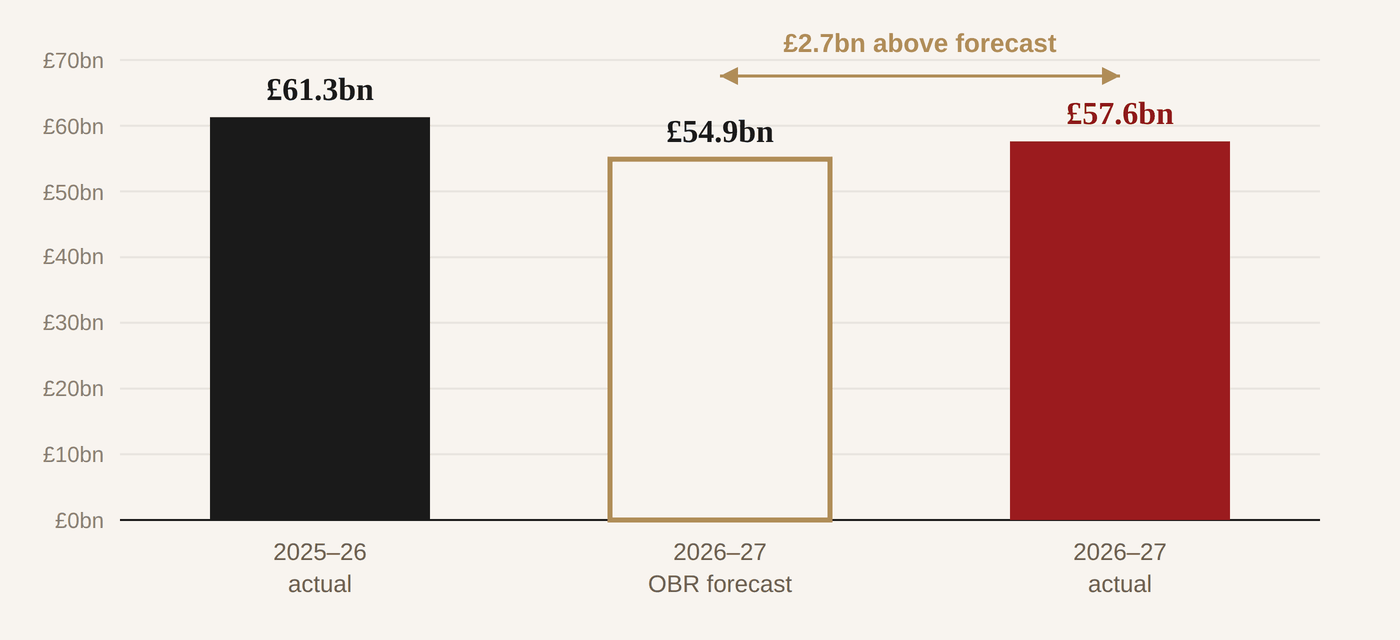
Public sector net borrowing (excluding public sector banks), cumulative April–June. Sources: ONS, Public Sector Finances, UK: June 2026; OBR, March 2026 monthly profile. Published 21 July 2026.
Borrowing fell in each of the first three months of the financial year: £23.0bn in April, £18.6bn in May, £16.0bn in June — the April and May figures both revised down from earlier estimates, which is most of why the year-to-date total, £57.6bn, looks better than it did a month ago. June's outturn came in £0.3bn below the OBR's forecast for the month, the first undershoot of the year.
The sequence is encouraging, though three monthly observations do not establish a trend. It does not change the starting point: the public sector has still spent £57.6bn more than it received in three months, £2.7bn ahead of what the OBR expected, and the new government has just committed a £850m revenue cost to a tax cut on electricity bills, funded, on the Government's own account, by savings still to be identified. Lenders who buy the gilts covering the gap are charging among the most for the privilege in almost three decades.
|
|
|
— Watch & Listen
Pudner on Burnham's tough choices
Damian Pudner · The Kelvin MacKenzie Show · This week
Damian Pudner's weekly appearance on The Kelvin MacKenzie Show, this week on Burnham's arrival in Downing Street and the coming "revolution" if tough decisions on spending and supply-side reforms aren't made.
Pudner on The Broker Collective Podcast
Damian Pudner · The Broker Collective · This week
Damian Pudner joins The Broker Collective podcast to talk gilts, mortgage costs, and the outlook for the property market.
|
|
|
— Inflation · ONS, June 2026
2.6%
CPI, 12 months to June 2026 — down from 2.8% in May
Headline Cools. Services Inflation Barely Budges
June's inflation figures gave the Bank a mixed picture: the headline rate fell, but a key measure of domestic price pressure barely moved.
| CPI (June) |
2.6% |
| Core CPI |
2.6% |
| Services CPI |
3.6% ▲ |
| Goods CPI |
1.7% |
| Food Inflation |
1.7% |
Source: ONS Consumer Price Inflation, UK: June 2026, published 22 July 2026.
A better-than-expected 2.6% CPI print (2.7% expected) — but likely short-lived, with June's data collected before July's 13% Ofgem cap rise and the new spike in oil prices. See our full analysis here.
|
|
|
— Energy
Brent Breaches $100 Before Retreating. The Energy Shock Is Not Over
Oil touched a fresh high this week.
| Brent Thu Settlement |
above $100 |
| Brent Fri Settlement |
$96.78 |
| Week Change |
+9.9% ▲ |
Brent crude settled above $100 a barrel on Thursday for the first time since May, after Houthi attacks on two tankers carrying Saudi oil intensified fears of disruption to Saudi Red Sea export routes. It fell 3.9% to $96.78 on Friday, but still gained 9.9% over the week.
|
|
|
— Gilt Markets & Sterling
The Bond Market's Verdict Gets Louder
Yields climbed for a fifth straight week. The pound and share prices held up better.
| 10yr Gilt (Fri late) |
5.03% ▲ |
| 30yr Gilt (Fri late) |
5.72% ▲ |
| GBP / USD (Fri late) |
$1.332 |
| GBP / EUR (Fri late) |
€1.169 |
| FTSE 100 (Fri close) |
10,736 ▲ |
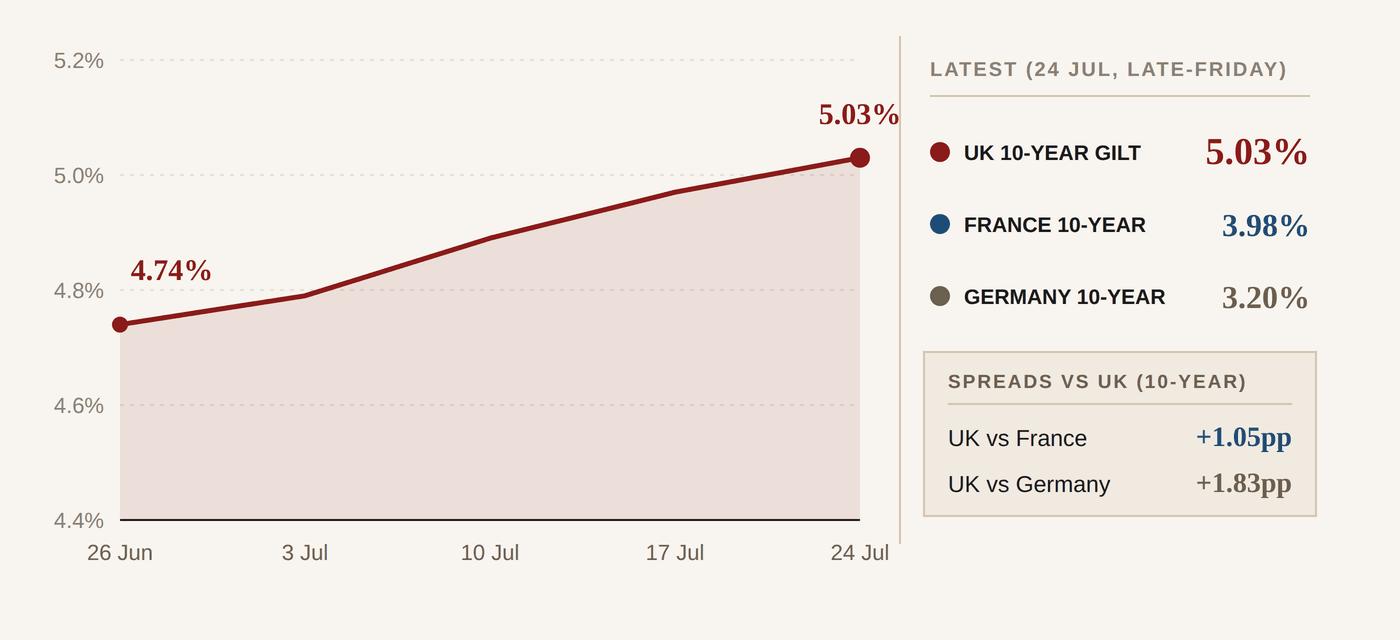
10-year government bond yields, late-Friday levels, weeks to 26 June–24 July 2026. Source: Reuters/Bloomberg/Trading Economics.
The 10-year gilt yield stood at 5.03% in late Friday trading, a fifth straight weekly rise; the 30-year reached 5.72%. Both remain just short of the peaks they set on 15 May — 5.15% and 5.822%, the latter a 28-year high for the long bond. Britain now borrows for ten years at 1.05 percentage points more than France and 1.83 points more than Germany.
|
|
|
— Political Economy
A New Cabinet Takes Shape
Healey's Treasury pledges fiscal discipline. Parliament won't get to test it until September.
Andy Burnham named his top team this week. John Healey took the Treasury; Angela Rayner returned to Government as Housing Secretary; Wes Streeting was brought back to Cabinet as Defence Secretary. Starmer supporters Rachel Reeves, David Lammy, Peter Kyle and Darren Jones all left. Miliband moves to the Foreign Office; Mahmood and Pat McFadden were reappointed to their existing posts at the Home Office and Work and Pensions respectively, and Jonathan Reynolds returns to an enlarged business department.
Healey used his first speech to Treasury staff to call fiscal discipline his “first duty” and commit to meeting the fiscal rules with a buffer against shocks.
Parliament will not scrutinise any of this in ordinary sittings before September: the Commons rose for recess on 16 July and does not sit again until 1 September, though a recall remains constitutionally possible.
|
|
|
— Global Context
A brief run above $100 oil is a Westminster problem.
The Gulf, Again
Brent's spike past $100 has its roots entirely outside the UK, but the transmission into Britain's own inflation and growth numbers is direct. Houthi forces attacked two tankers carrying Saudi oil this week, intensifying fears of disruption to Red Sea export routes that exist specifically to bypass the Strait of Hormuz. Roughly a fifth of the world's oil passes through that strait; existing pipelines and alternative export routes could replace only a fraction of the displaced volumes. Three major central banks decide on rates within three days of each other this coming week — the Federal Reserve on Wednesday, the Bank of England on Thursday, and the Bank of Japan on Friday — each taking its own view of how lasting this latest oil shock will prove.
|
|
|
— Further Reading · This Week from GBTT
|
Editor's Pick
Damian Pudner · CapX · 23 July 2026 · 5 min read
| |
| “I would aim for annual savings of around £57bn — and use every pound to cut taxes on employment, earnings and investment.” |
| |
Pudner sets out a £57bn plan to cut welfare spending by the end of the Parliament — £22bn from sickness and disability benefits, £15bn from replacing the triple lock with an earnings link, £20bn from freezing working-age benefits and cutting fraud — recycled into lower employer National Insurance, income tax and corporation tax.
|
|
Most Read
GBTT Research · gbtt.info · 20 July 2026 · 11 min read
| |
| Your share of Britain's oil fund: £0. |
| |
Britain didn't squander a Norwegian-sized oil fund — there was never one to waste. Modelling HMRC's oil receipts against Britain's actual public finances from 1976 to 2010, GBTT finds the fund Britain could honestly have saved was worth about £60bn, not the £450–850bn campaigners cite, and even that fantasy version is wiped out by the 1990s recession and the 2008 crash.
|
The Oldest Mistake in Economics
Ben Ramanauskas · gbtt.info · 25 July 2026 · 5 min read
From the pharaohs to Diocletian's Rome, price controls have repeatedly failed. Ramanauskas argues that Burnham's £2 bus-fare cap reaches for the same broken lever, and that the real answer to the cost of living is supply-side reform, not meddling with prices.
The Boriswave Settlement Time Bomb
Charlie · gbtt.info · 21 July 2026 · 6 min read
Up to 2.2 million migrants from the post-2021 “Boriswave” are approaching the five-year mark for Indefinite Leave to Remain. With reports the Home Office may water down settlement reforms, and Reform UK putting one cohort's lifetime fiscal cost at £622bn, Charlie argues this is the wrong moment to blink.
Stamp Duty: Britain's Most Damaging Tax
Ben Ramanauskas · gbtt.info · 20 July 2026 · 6 min read
Stamp Duty is a one-off toll charged the moment a family tries to move, trapping empty-nesters and young families in homes that no longer fit. Ramanauskas sets out the case — including the Adam Smith Institute's estimated £20bn annual boost from abolition — for scrapping it immediately.
|
|
|
— Next Week · Mon 27 – Fri 31 Jul 2026
Three Things to Watch
| 1 |
Wednesday 29 July · Bank of England · 9:30am
Money and Credit, June 2026
The Bank's monthly read on mortgage approvals and money supply (M4ex). May's reading showed house-purchase approvals at their lowest since December 2023.
|
2 |
Thursday 30 July · Bank of England · 12pm
MPC Decision & Monetary Policy Report
Bank Rate has been held at 3.75% since June's 7-2 vote. Persistent services inflation and this week's oil shock leave the decision live between another hold and a rise.
|
3 |
Wed 29 (Fed) & Fri 31 July (BoJ)
Fed and BoJ Also Decide on Rates
A Fed move shifts the dollar and, with it, the sterling cost of dollar-denominated oil, potentially feeding into Britain's own inflation outlook.
|
|
|
|
GBTT.
Data. Not Vibes.
GBTT Weekly Briefing · Issue #11 · 26 July 2026
gbtt.info
Sources: ONS, Bank of England, HM Treasury, OBR, S&P Global/CIPS, GfK/NIQ, Cornwall Insight, Ofgem, GOV.UK, Federal Reserve, Reuters, Bloomberg, Trading Economics.
Market levels: Reuters/Bloomberg/Trading Economics, Friday 24 July 2026 — closing prices where stated, late-session levels (approx. 12:30pm BST) otherwise. For information only. Not investment advice.
|
|
