
19 Jul 2026
Weekly Briefing
Think Tank
gbtt.info
This week's briefing is shorter than usual. The GBTT team has been out and about, not least at CPAC Great Britain over the past few days. Normal service — and the usual weight of charts — resumes next week.
Britain gets a new prime minister on Monday, probably a new chancellor too, and an economy that has expanded for six consecutive rolling three-month periods. The bond market is not applauding.
Burnham's coronation was never seriously in doubt once Wes Streeting and Ed Miliband declined to stand. He was declared Labour leader on Friday with the backing of 379 of the party's 403 MPs and is expected to be appointed prime minister by the King on Monday, before unveiling his Cabinet later that day. He will be Britain's seventh prime minister in a decade. Keir Starmer, removed by his own MPs rather than the electorate, becomes the sixth to leave office since the 2016 referendum. Rachel Reeves is expected to leave the Treasury with him. Shabana Mahmood is favourite for the Treasury. GBTT would keep her at the Home Office and send Wes Streeting to No. 11.
At Tuesday's Mansion House dinner, Andrew Bailey, Governor of the Bank of England, urged the incoming government to confront Britain's productivity problem without reaching for crude deregulation. Well-designed financial rules, he argued, can support growth rather than smother it. He also renewed his call, as chair of the Financial Stability Board, for international regulators to coordinate the testing of powerful AI models before their public release. Both messages were directed as much at the next government as the last.
The growth Bailey wants protected is real, if hardly spectacular. GDP rose 0.7% in the three months to May compared with the preceding three months — the sixth consecutive rolling three-month expansion. Services grew 0.7%, construction 1.6% and production edged up 0.1%. But the pace slipped from April's 0.8%.
Then there is the Gulf. Brent surged almost 16% to $88.10 after the latest US-Iran ceasefire collapsed and missiles struck two UAE-flagged tankers in Omani waters. Cornwall Insight's latest autumn price-cap forecast predates the move. It already looks stale.
Burnham inherits slow growth, an unforgiving bond market and an energy bill once again being written in the Strait of Hormuz. Welcome to Number 10.
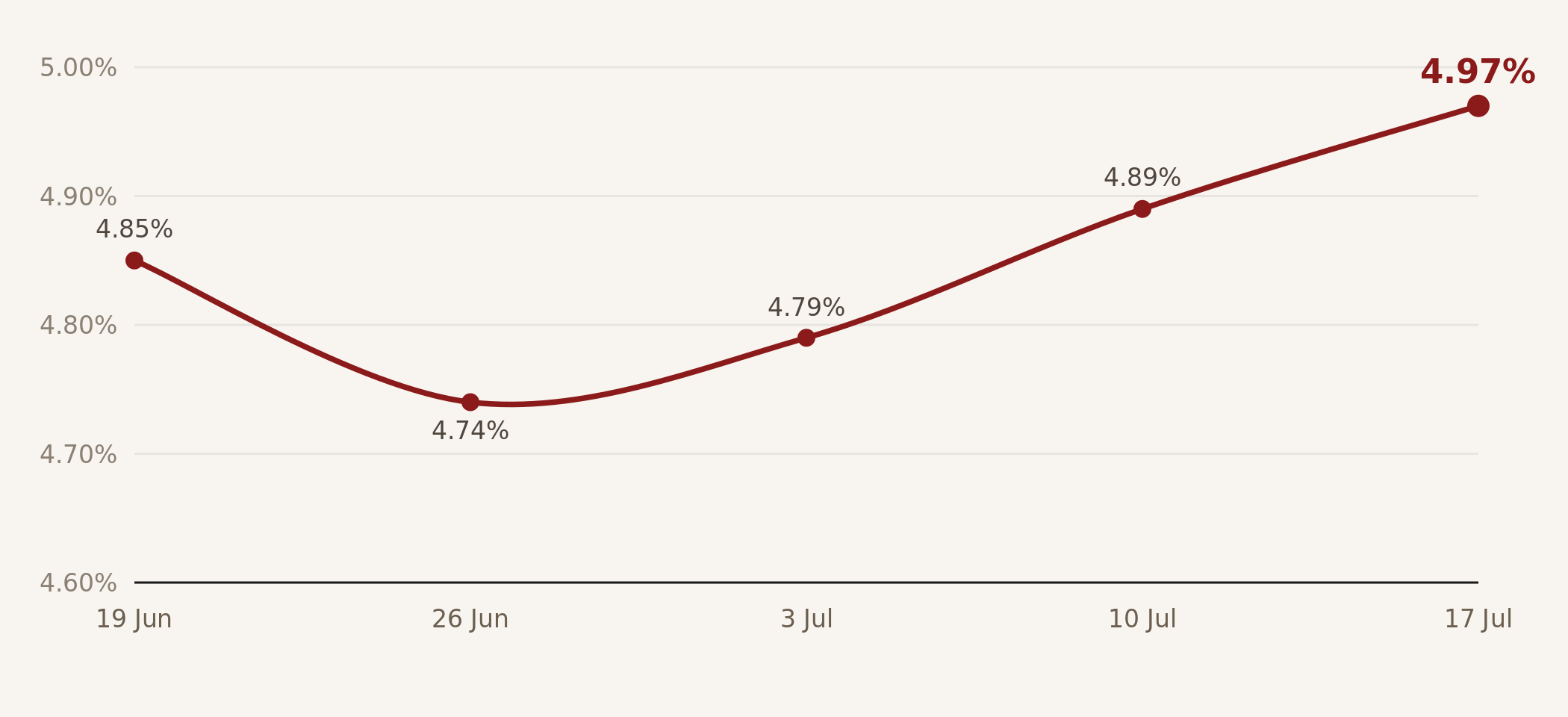
The bond market's verdict, so far, is a repricing rather than a revolt. The ten-year gilt yield extended its climb to 4.97% on Friday — the third straight weekly rise, detailed above — and the trend began well before Burnham's nomination was a formality; it also reflects continuing fiscal and inflation concerns, including the OBR's debt warning covered in this briefing last week. Sterling and the FTSE showed no comparable alarm: sterling firmed modestly against both the dollar and the euro over the week, and the FTSE gained almost 1%.
The real test starts Tuesday. June's figures will show whether May's £5.6bn overshoot was a one-off or the beginning of wider fiscal slippage — under a government that inherits the number rather than having shaped it. Markets are likely to treat it as an early marker for the new administration all the same.
The ten-year gilt closed at 4.97% and the 30-year at 5.67%. Sterling firmed modestly, while the FTSE 100 gained 103 points to 10,600.37. Reuters attributed Friday's equity rise chiefly to utilities and energy shares. There was no evident political-risk sell-off.
Brent crude closed Friday at $88.10 a barrel, up almost 16% on the week, after the latest US-Iran ceasefire broke down and Iranian cruise missiles struck two UAE-flagged tankers in Omani waters. The US also reinstated its naval blockade of Iranian ports. The latest available forecast for the October–December energy price cap was calculated using market prices at the close on 29 June and published by Cornwall Insight the following day. It put the annualised bill for a typical dual-fuel household at £1,849 under the former consumption benchmark — around 0.7% below July's equivalent figure of £1,862 — or £1,654 under Ofgem's revised benchmark, around 0.5% below July's equivalent figure of £1,663. The revised consumption assumptions took effect on 1 July. These are two presentations of the same forecast, based on different assumptions about typical household energy use — not a sudden reduction in prices. Brent does not feed mechanically into the household cap, but renewed disruption in the Gulf has plainly shifted wholesale energy risks upwards since the forecast was produced. Ofgem will announce the actual October–December cap by 26 August.